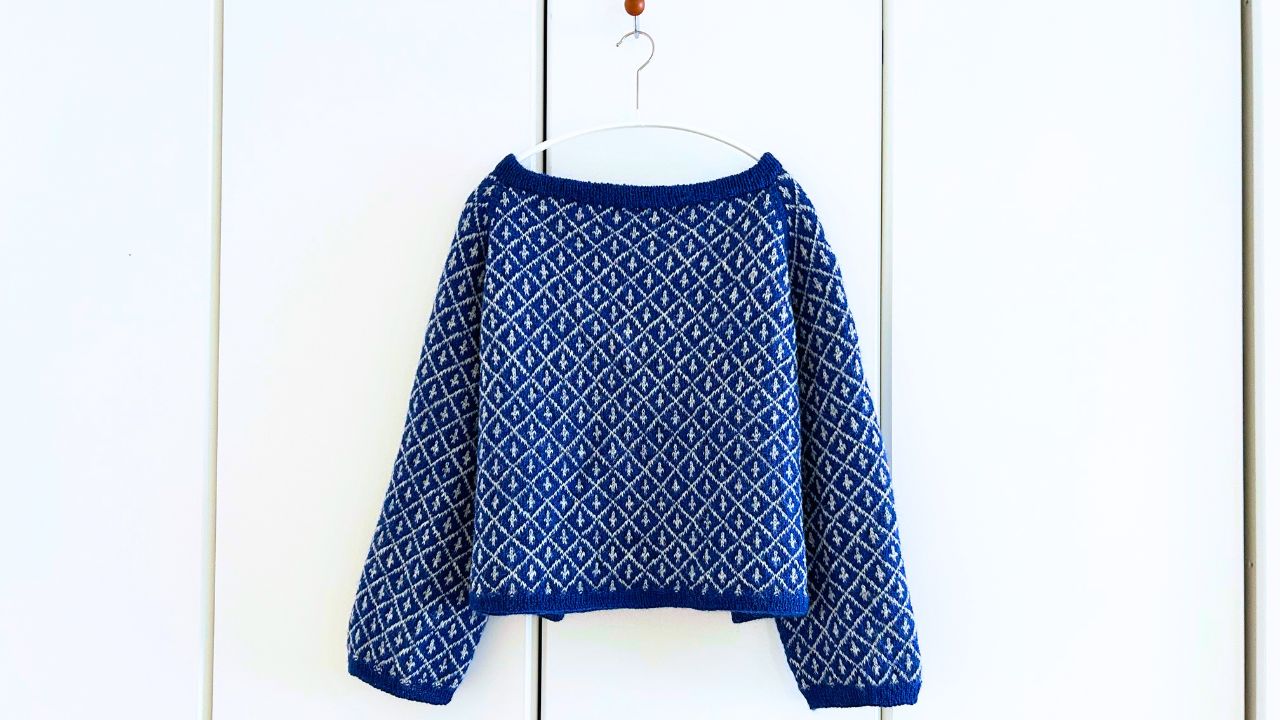
I finally finished knitting “Cross”, a design featured in the amuhibiknit book, which I started last December.
The pattern calls for Puppy British Fine yarn.
The combination of deep blue and light gray is absolutely beautiful, and it was such a joy to knit.
You can also find this pattern on Ravelry, so even if you don’t live in Japan, you can purchase and knit it!
👉 Ravelry pattern page。
Using the recommended yarn — Puppy British Fine

I used Blue (007) and Gray (010).
In the book, the model wears this color combo with a white skirt—it’s a perfect match.
Both are the same yarn, but when knitting, I noticed that the blue strand was noticeably thinner.
If you want to substitute yarn, I think any Light Fingering weight will work well.
Comparing yarn thickness between Blue and Gray
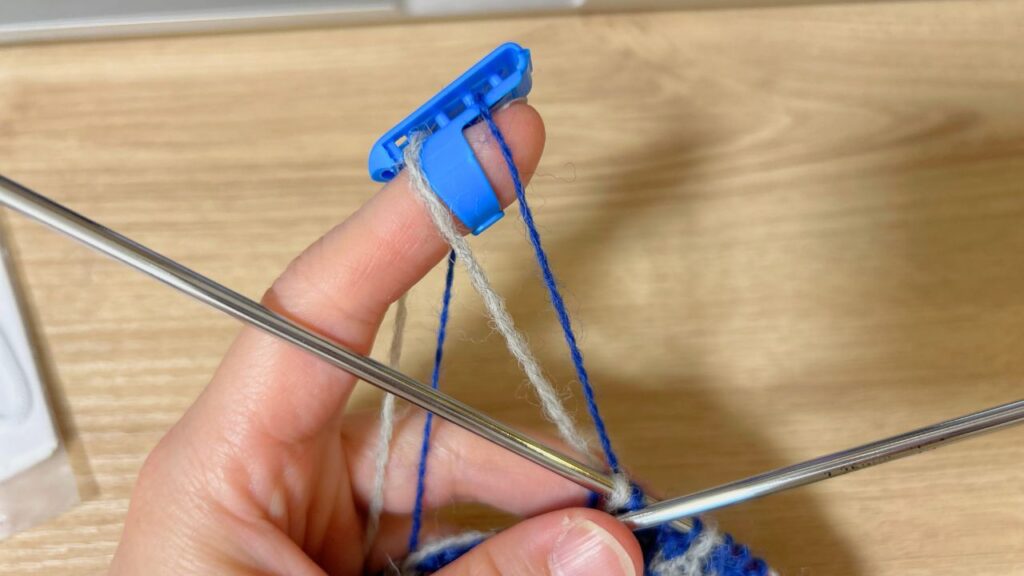
※Puppy British Fine: Comparison of Thickness by Color
l though it’s hard to tell from photos, the blue yarn feels a bit finer than the gray.
It wasn’t just one skein—throughout the project, the blue stayed thinner overall.
A friend of mine mentioned the same thing: “Some skeins of British Fine are unusually thin.”
At this point, it’s not just British Fine — it’s British Super Fine! 😄
Since the gray yarn runs behind the blue, the fabric doesn’t look sparse,
but if you look closely, you can see that the blue strand is definitely thinner.
Whenever I found sections that felt too fragile, I cut them and reinforced the joins later.
Knitting notes
There’s nothing particularly difficult about the pattern — just follow the chart as written and you’ll be fine.
Tip: How to handle long floats
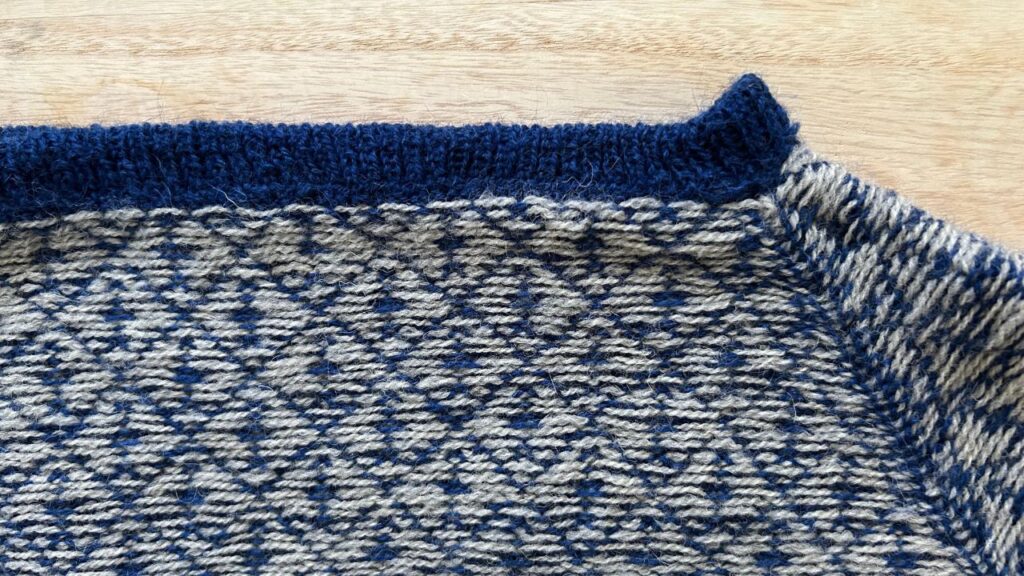
When floats run over five stitches, I usually catch the yarn in the middle.
However, I saw designer Mikiko Umemoto mention on Instagram that she doesn’t catch floats at all —
and that made me think, “That’s totally okay too.”
Catching floats helps prevent snagging when wearing, but it’s not always necessary.
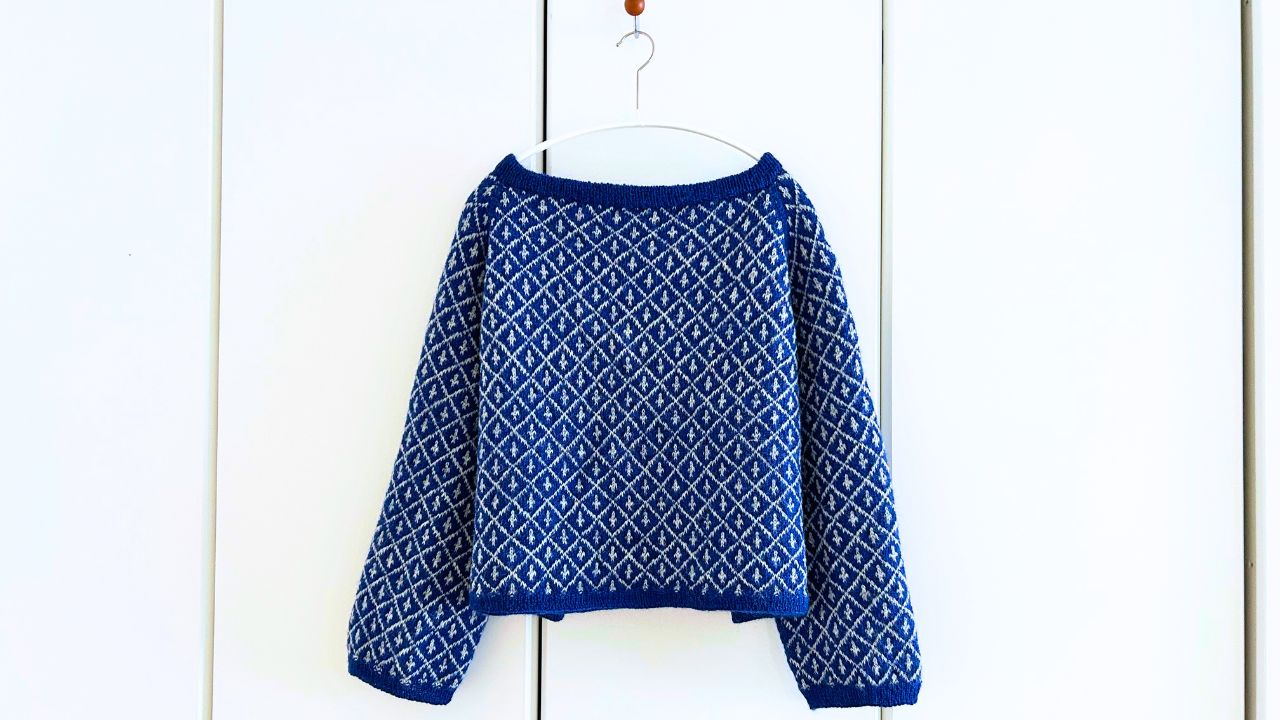
Finished piece — the cropped length pairs perfectly with wide bottoms (well, almost)
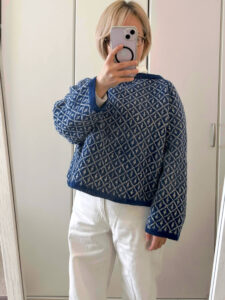
When I tried it on, it looked even better than I expected!
Friends at my knitting meetup also said, “That color really suits you!” — and they were right.
The overall colorwork pattern looks complex, but once you get into rhythm, it’s pleasantly meditative.
Since it only uses two colors, I’d actually recommend it as a first colorwork project.
That said… mine turned out a bit larger than planned.
I didn’t properly swatch 😅 — and the book lists Japanese size 3 (3.0 mm) and size 2 (2.75 mm) needles,
but I used 3.25 mm, which is slightly thicker than the Japanese size 3.
So I suspect if I had used the actual 3.0 mm needles, the fit would’ve been just right.
Definitely knitting this again — next time, without a yarn guide!
This time I used a yarn guide for colorwork,
but at a knitting meetup, someone showed me an easy way to hold both yarns in the French style,
without needing a guide.
So next time, I’ll try knitting without the yarn guide and without catching floats —
maybe in another color combo.
…Though, who knows when that will be. My knitting queue is pretty full right now! 😅。
Related post
If I had used Japanese size 3 (3.0 mm) needles instead of US 3 (3.25 mm),
the fit would’ve been perfect.
Recently, more Japanese books are listing overseas needle sizes,
so I made a comparison chart for Japanese vs. international knitting needle sizes.
It’s handy when checking gauge or buying new needles — feel free to use it:
👉 Knitting Needle Size Comparison Chart