Interestingly, many long-time Japanese knitters say they’d never even heard of wet blocking until recently. With more posts advocating wet blocking, some people worry:
- “Was I doing it wrong?”
- “Is this a new trend?”
- “Why didn’t anyone teach me this?”
So I answered them this way—
Here’s the conclusion:
👉 Wet blocking is sometimes necessary.
👉 And sometimes completely unnecessary.
Neither is “right” or “wrong.”
The truth is simple:
Why Some Japanese Knitters Are Only Now Hearing About Wet Blocking

Wet blocking itself didn’t suddenly become trendy in Japan.
What changed—quietly and gradually—were the types of yarns people were using.
And because the shift happened slowly over the years, many long-time Japanese knitters simply never noticed it.
For decades, Japanese knitters mainly worked with domestic yarns that were exceptionally well-scoured, stable, and consistent in quality. Steam blocking alone produced beautifully even results, so wet blocking never became a standard step.
But today, the yarn landscape in Japan has expanded dramatically.
That’s the real reason “wet blocking” has become a topic of conversation.
The Yarn Situation in the Past (up to the 2000s)
For a long time, most yarns available in Japan were produced by domestic manufacturers known for:
- meticulous scouring (cleaning)
- stable finishing processes
- excellent colorfastness
- very consistent quality
Because of this, Japanese knitters didn’t need to wet block.
Steam blocking was sufficient to relax stitches, even out fabric, and achieve a polished finish.
In other words, the reason many veteran Japanese knitters never learned wet blocking is simple:
They genuinely didn’t need it.
Their yarns were already that well-finished.
It wasn’t a missing step—it was a reflection of Japanese yarn standards at the time.
The Yarn Situation Today (the “Now”)
In the last decade, the range of yarns available in Japan has exploded. Now you can easily buy:
- hand-dyed yarns from overseas
- industrial cone yarns
- yarns containing recycled fibers
- yarns with minimal or inconsistent scouring
- fibers with weaker fixation or color-setting
These newer yarns often behave differently:
- they may feel waxy, oily, or stiff
- they may bloom only after washing
- they may relax dramatically in water
- they may shed excess dye or spinning oil
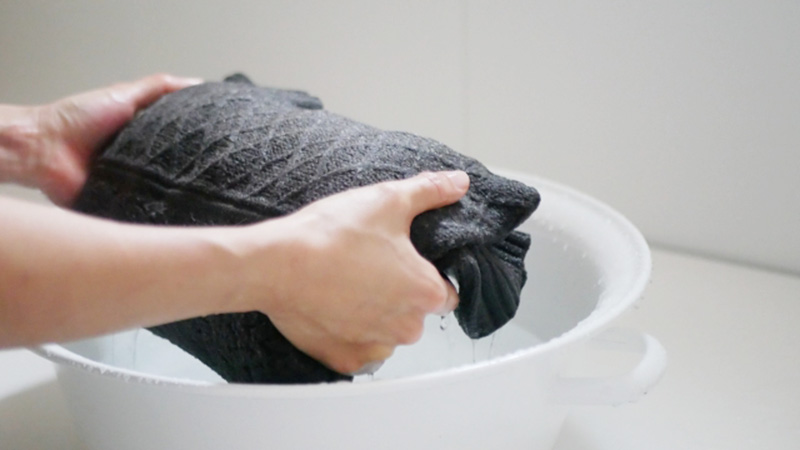
With these yarns, wet blocking becomes extremely useful, because water (and mild detergent) helps them reach their intended texture and final size.
That’s why water-based finishing suddenly feels more visible—
not because it’s a new technique, but because the yarns themselves have changed.
Why Veteran Japanese Knitters Feel Surprised

On platforms like Threads, many experienced Japanese knitters say things like:
- “I never learned this!”
- “Was I doing it wrong?”
- “Is this a new trend?”
And the confusion is completely understandable.
They followed the correct finishing methods for the yarns of their era.
Their teachers and textbooks didn’t include wet blocking because:
It simply wasn’t necessary in Japan at the time.
So when they now encounter wet blocking—often through newer yarns or overseas trends—it feels sudden, even though the change happened quietly over many years.
Nothing about their past practice was “wrong.”
The materials have changed, so the finishing methods have expanded.
That’s all.
When Wet Blocking Is Needed / Not Needed
Yarns that benefit from wet blocking
- hand-dyed yarns
- yarns from international brands (rather than Japanese manufacturers)
- industrial (cone) yarns
- yarns containing recycled fibers
- yarns that feel oily, waxy, or stiff
- fabrics that feel tight or rigid
Water helps these yarns bloom, relax, and stabilize in size.
Because this article is for knitters living outside Japan, chances are that many of the yarns you use do need wet blocking.
Yarns that don’t require wet blocking
- most mainstream Japanese yarns (worsted / DK equivalents)
- well-scoured, colorfast yarns
- yarns already soft and stable
- fabrics that look great with steam alone
For these, the traditional Japanese method—steam blocking—is still perfectly effective.
Before long, blocking might become completely normal in Japan as well.
Here’s what I told knitters — even the experienced ones — who had never really heard about wet blocking:
“The old way wasn’t wrong at all.
It was simply perfect for the yarns we used back then.Today we have a much wider range of yarns, so naturally the finishing options have expanded too.
Knowing both approaches doesn’t make things harder — it just gives you more freedom.”
So who knows— in the near future, wet blocking might become a totally ordinary step for Japanese knitters (and crocheters) too.
Related Article
For those who want step-by-step instructions, here’s a practical guide using mohair as an example (but the basics apply to any yarn):