I knitted this project using the Japanese version of the pattern. An official English version is also available.
If there are any discrepancies, they may be due to translation differences between the Japanese and English patterns.
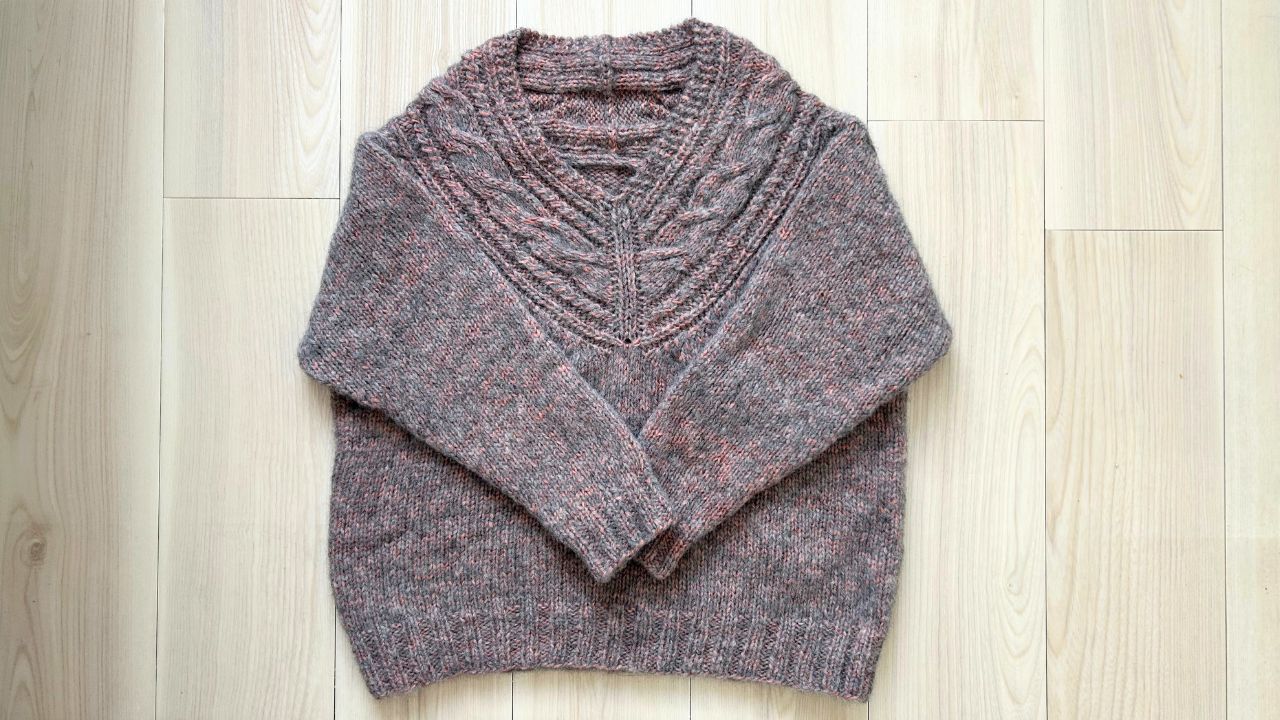
I had been working on Early Summer as a stash-busting project for quite some time, but I ran out of yarn midway and had to abandon it.
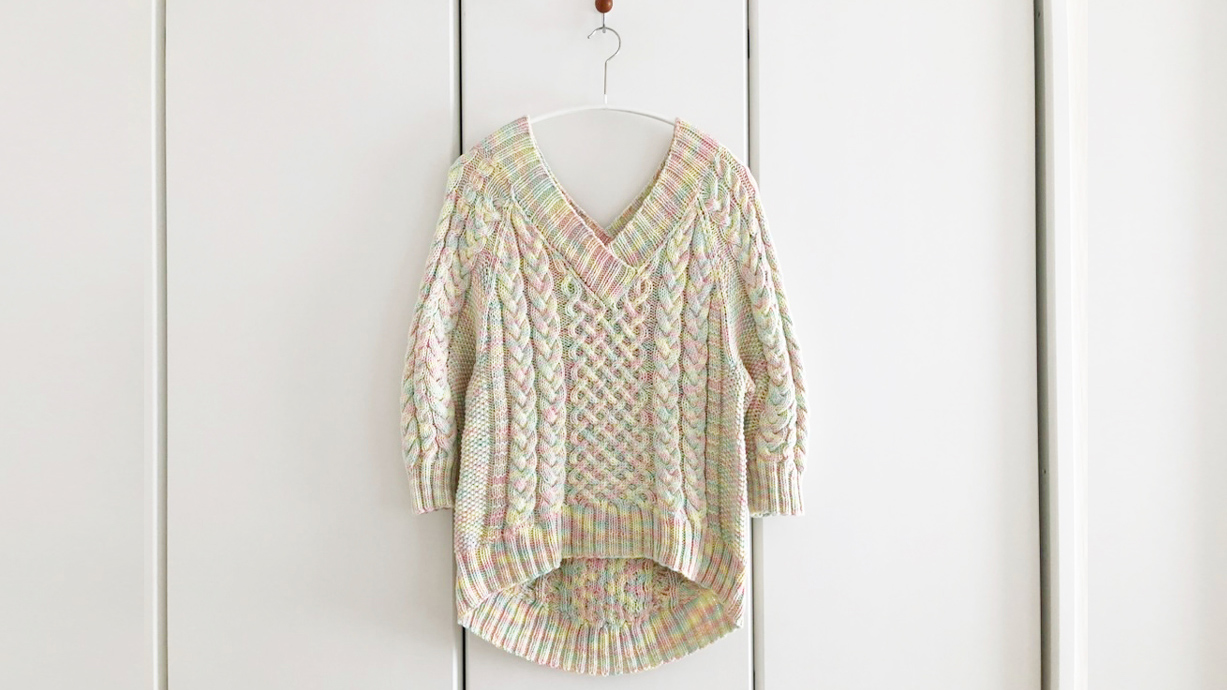
This time, I finally completed it using a different yarn.
Originally, I started this project with a speckled yarn from a Japanese indie dyer paired with a recycled cotton. Unfortunately, I didn’t have enough yardage, so I decided to resume the project with a substitute yarn instead.
In this article, I’ve summarized the trial and error that led to finally finishing Early Summer.
The Recommended Yarn vs. My Substitute Yarn for Early Summer
The recommended yarn for the Early Summer knitting pattern is DMC Natura Denim.
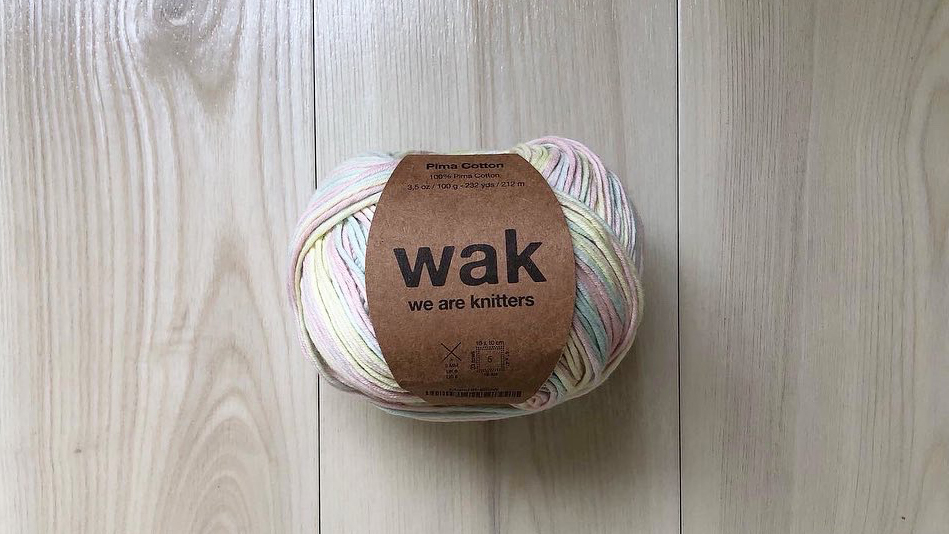
For this project, I chose We Are Knitters The Cotton from my stash as a cotton yarn substitute.
Before starting, I did a basic yarn comparison to see whether The Cotton would work as a substitute for DMC Natura Denim.
This yarn comparison focuses on needle size recommendations, fiber content, and overall suitability as a cotton yarn substitute.
| Item | Natura Denim (Recommended) | THE COTTON (Substitute |
| Suggested needle size | 4~5mm | 5mm |
| Fiber content | 100% Cotton | 100% Pima Cotton |
Overall, the thickness and fiber characteristics are very similar, making them a good match.
Next, I checked the needle sizes specified in the pattern.
-
US 5 – 3.75 mm
-
US 6 – 4.0 mm
-
US 7 – 4.5 mm
*The largest needle size is used for the main textured stitch pattern.
I wanted to knit one size larger, so I decided to go up one needle size.
That led me to 5.0 mm (Japanese size 10)—which perfectly matches the recommended size for THE COTTON.
In short, if you want to knit one size up without changing stitch or row counts, We Are Knitters’ THE COTTON works extremely well as a substitute for DMC Natura Denim.
That said… I started knitting without swatching first.
Please don’t do that.
Always knit a gauge swatch 😅
Knitting Tips and Common Pitfalls in the Early Summer Project

Here are some points I personally found tricky, along with tips that helped me get through the project.
Short Rows in the Early Summer Pattern – Switching to German Short Rows
The pattern’s short-row method seemed to be something like
“turn, yarn over, and later work two stitches together” (at least, that was my understanding), but I found it a bit confusing.
Since the pattern included a note about wrap and turn, I initially used W&T.
However, I kept forgetting to pick up the wraps when resolving the short rows.
Eventually, I switched to German Short Rows, which worked much better for me.
As long as your stitch and row counts line up, substituting a technique you’re comfortable with makes the process much smoother.
The Hardest Part Wasn’t the Pattern – It Was the Yoke Decreases
At first glance, the textured stitch pattern looks intimidating.
In reality, the true nightmare (!) was the yoke decreases.
The construction combines the body and sleeves, works part of the yoke in the round, and then switches to flat (back-and-forth) knitting.
If you read it calmly, it should make sense—but somehow my stitch counts kept going off.
I had to reknit the left side five times and the right side three times.
Because decreases are worked on both RS and WS rows, the key takeaway is this:
Check your stitch count after every single row.
It really is the shortest path to completion.
How to Interpret “Edge 1 Stitch, Decrease 2 Stitches”
The instruction literally says something like “maintain 1 edge stitch, decrease 2 stitches,” but it wasn’t clear whether that meant:
- working k2tog twice, or
- a k3tog, or
- some other method.
In the end, I chose k3tog whenever this instruction appeared.
I wasn’t 100% confident, but it worked out structurally, and the shape looks fine.
When to Remove Stitch Markers – A Common Trap
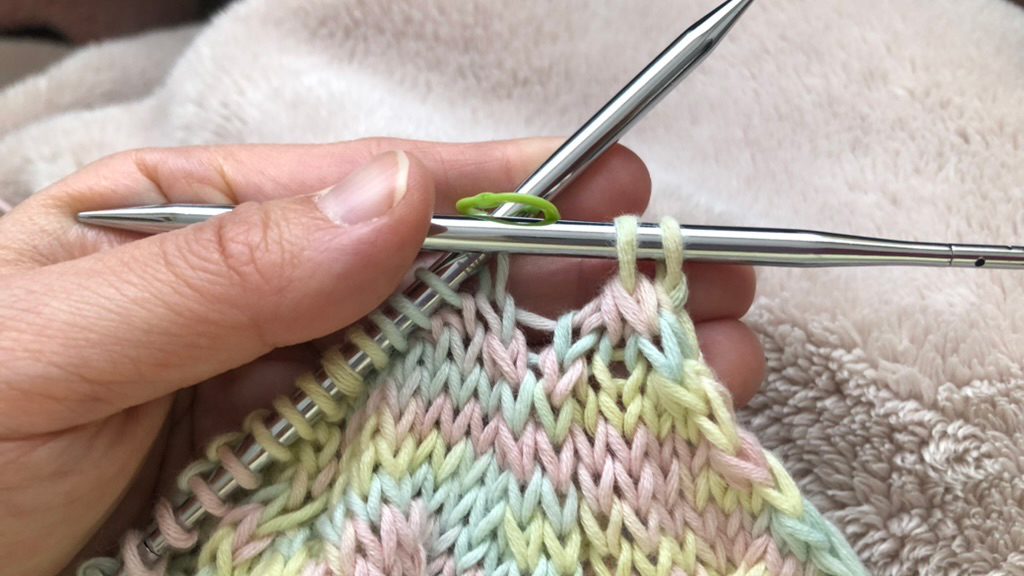
As you continue decreasing on both sides, the raglan lines start to intersect with only three rows remaining.
On Row 26, the pattern gives instructions like:
k2tog → SM (slip marker) → ssk
But in practice, you can’t knit it as written unless you remove the marker at that point.
(The pattern says to remove markers on Row 27…)
This may be a typo specific to the Japanese edition.
In the end, I adjusted the decreases by eye—keeping the stitch count consistent and making sure the texture pattern stayed intact.
As long as the raglan lines don’t look twisted (k2tog vs. ssk direction), it will be fine.
Why I Recommend a Tubular Bind-Off for the Neckline
For the neckline, the pattern allows either:
- a standard bind-off, or
- a tubular bind-off (2×2 rib)
I tried both for comparison.
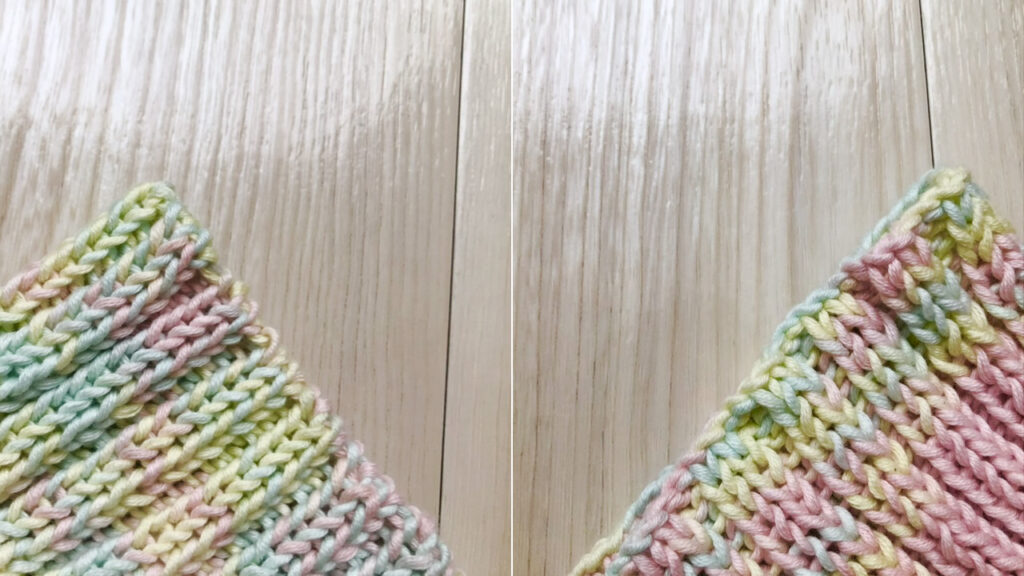
- Standard bind-off: Easy and stable, but slightly wavy.
- Tubular bind-off: More work, but far cleaner and more polished.
I’m not great at tubular bind-offs, and I had to redo it three times on each side—but the final result was worth it.
Cotton yarn doesn’t thin out easily when reworked, so I’m glad I kept trying until I was satisfied.
Finally Finished After Three and a Half Years
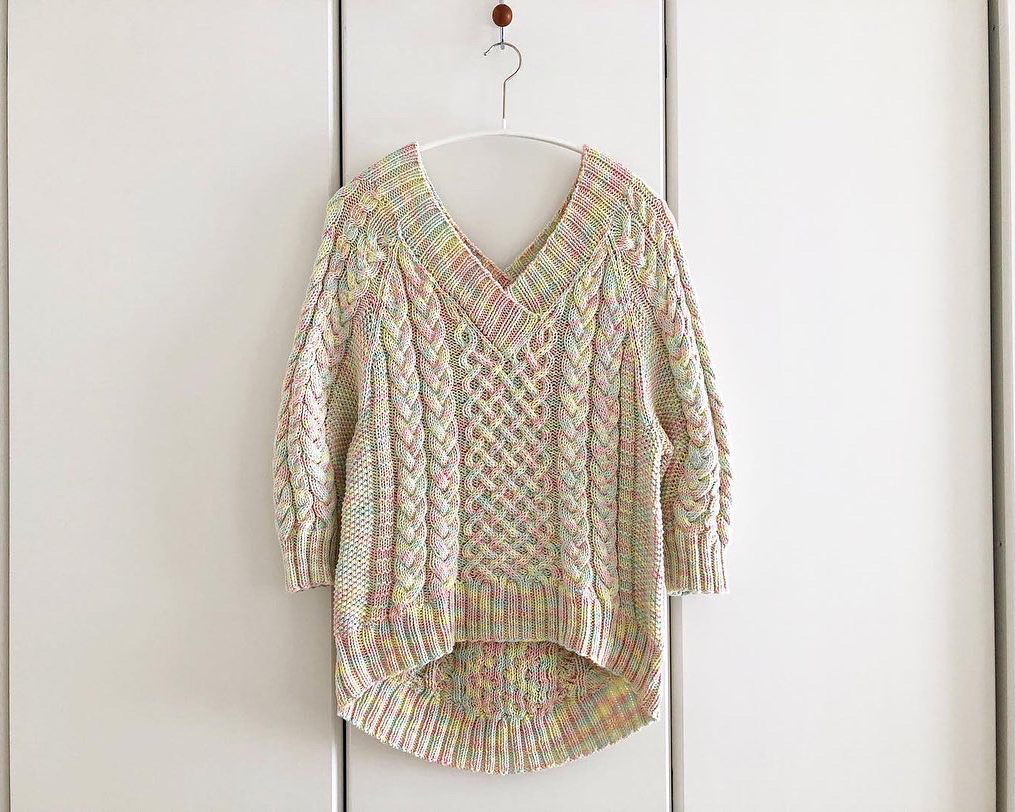
It’s finally done!
After trying it on, the fit is just right.
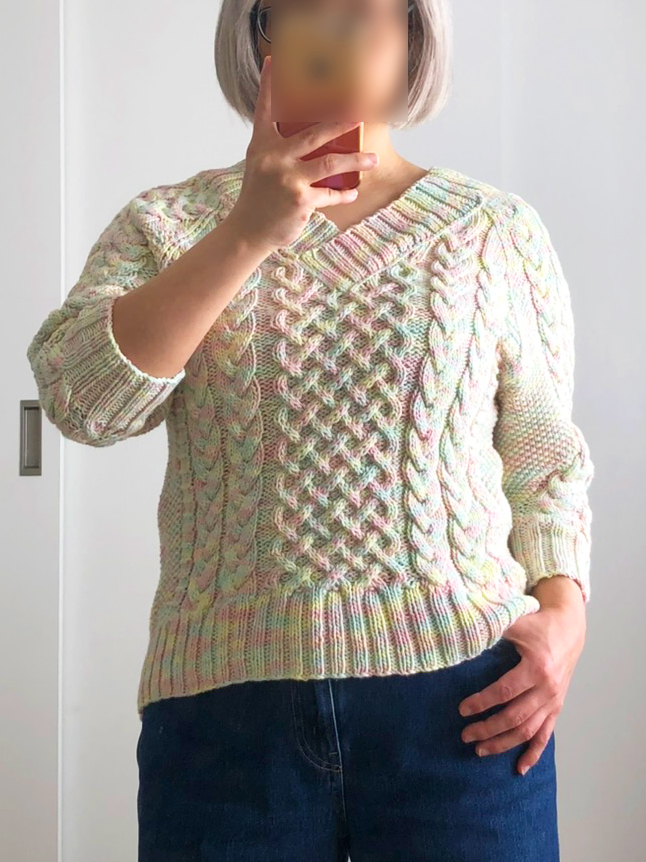
Yes.
This is good.
Three and a half years… that was a long journey.
I restarted this project beside my cat Ritchi, who crossed the rainbow bridge last month.
Knitting while thinking, “Ritchi is sleeping so peacefully beside me,” is now a precious memory.
Every time I look at this piece, I know I’ll remember her curled up next to me.
Rather than shouting
“Yay, it’s finished! It’s so cute!!”
what I really feel is:
“Hey Ritchi, I finally finished it.”
(I call myself “big sis” when talking to my cat—I was still a student when she was born.
She probably didn’t care, of course.)
True to its name, Early Summer is perfect for the coming season, with a great balance of structure and breathability.
If you enjoy a solid fabric even in warmer months, I wholeheartedly recommend this pattern.
Pattern:Early summer by Yuko Shimizu (Ravelry)
This project became a valuable lesson in yarn substitution, gauge decisions, and reading decrease instructions carefully in a knitting pattern.