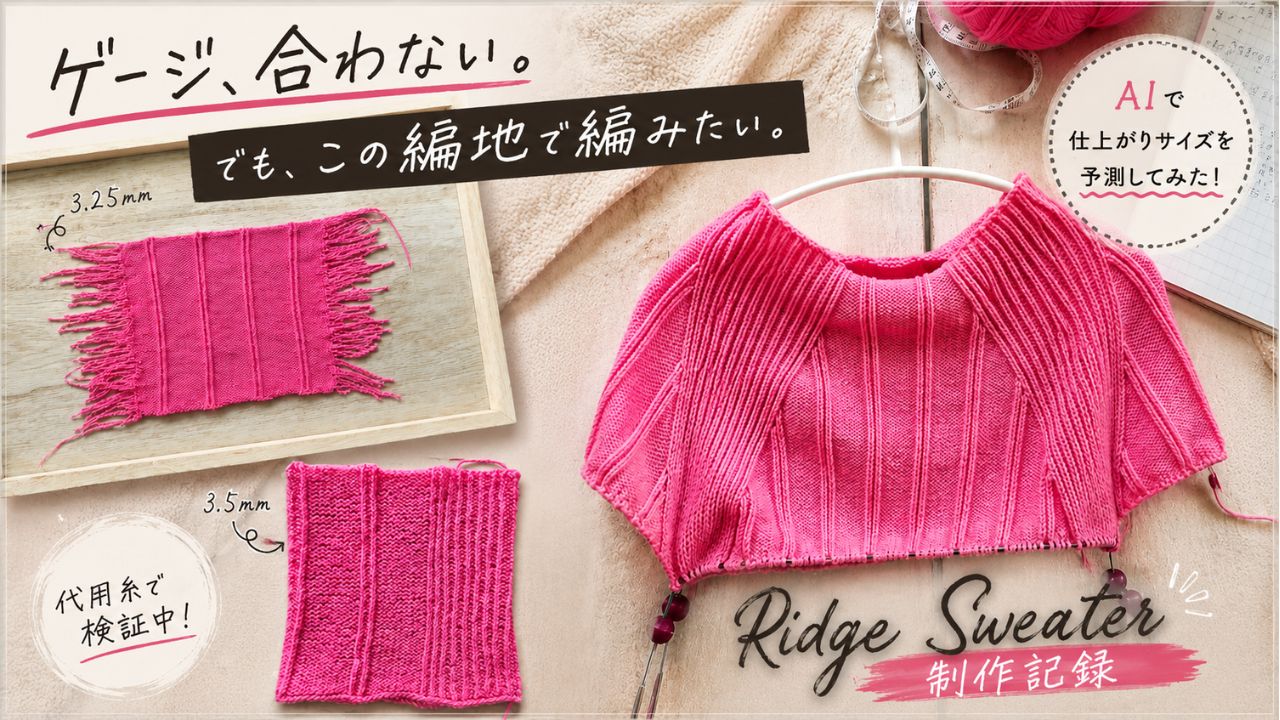
I made the key visual for this article with AI, by the way… but honestly, it still looks a little weird. This stuff is harder than it seems.
Why Flat Swatches Give Different Gauge — and How to Make a Better Circular Knitting Swatch
If you’ve ever wondered why your stockinette gauge changes when knitting in the round, your swatching method may be the reason.
Many knitters measure gauge using flat swatches, even for circular knitting projects. But because knit and purl tension are often different, flat stockinette swatches can produce inaccurate gauge measurements.
In this article, I tried the “correct” method for knitting a gauge swatch in the round using a fake in the round swatch technique. I also talk honestly about what felt difficult, awkward, and surprisingly convincing about the process.
So—do you actually swatch properly for knitting in the round?
To be honest, I’ve always been a bit vague about it myself.
I knew the proper method, but even for a swatch, I hated the idea of cutting yarn. So I kept measuring my gauge using flat stockinette swatches instead.
This time, though, I finally decided to try doing it the “correct” way.
Why Flat Stockinette Swatches Give Different Gauge

At the beginning of this article, I mentioned that I used to swatch flat even for projects worked in the round.
The problem is… that doesn’t actually give you an accurate circular knitting gauge.
For example, stockinette stitch is worked differently depending on whether you knit flat or in the round:
- Knitting in the round → knit stitches only
- Knitting flat → alternating knit and purl rows
And here’s the important part:
Your knit gauge and purl gauge are often not the same.
For me, my purl stitches are tighter.
When I asked some knitting friends, many of them said the same thing.
So when knitting flat:
- knit rows → normal tension
- purl rows → tighter tension
- result → a denser stockinette gauge than the actual project
But in a real circular stockinette project, you’re knitting every round.
Which means your gauge changes.
That’s why experienced knitters often say:
“If the project is knit in the round, your swatch should be knit in the round too.”
How to Knit a Fake Swatch in the Round
So now we know that if we want an accurate knitting in the round gauge, the swatch itself also needs to be worked in the round.
But realistically… knitting a full tube large enough to measure properly takes a lot of yarn and time.
And honestly, most of us just want to skip the swatch and start the actual sweater already.
Thankfully, there’s a popular trick for making a fake in the round swatch that saves both yarn and effort.
This method is demonstrated in a video by Brooklyn Tweed.
Here’s how the fake circular swatch works:
- Knit across the front side only
- Instead of turning, slide the swatch back to the other end of the needle
- Carry the yarn loosely across the back
- Knit across the front again
In other words, you’re effectively always knitting from the right side.
This creates a swatch that mimics stockinette knitting in the round without having to knit a full tube.
Once you’ve knitted enough rows, you cut the long floats on the back.
A Small Personal Preference About Swatching
Whether I’m knitting a flat swatch or a circular gauge swatch, I don’t bind off my swatches.
Instead, I simply run the yarn through the live stitches.
Why?
Because binding off changes the stretchiness of the fabric, and then I can’t properly evaluate how the knitted fabric behaves.
I also don’t add garter stitch borders to stabilize the edges.
Those borders won’t exist in the actual garment, after all.
If the edges curl—and they usually do—I just steam the swatch.
Because realistically, I’m going to steam the finished garment too.
Basically, I try to treat the swatch the same way the real project will be treated.
…Though despite all that, I still mess up sizing fairly often.
My Experience Trying a Proper Knitting in the Round Gauge Swatch

So anyway—I tried the exact fake in the round swatch method demonstrated in the Brooklyn Tweed video.
Here’s how the swatch looked before cutting the floats:
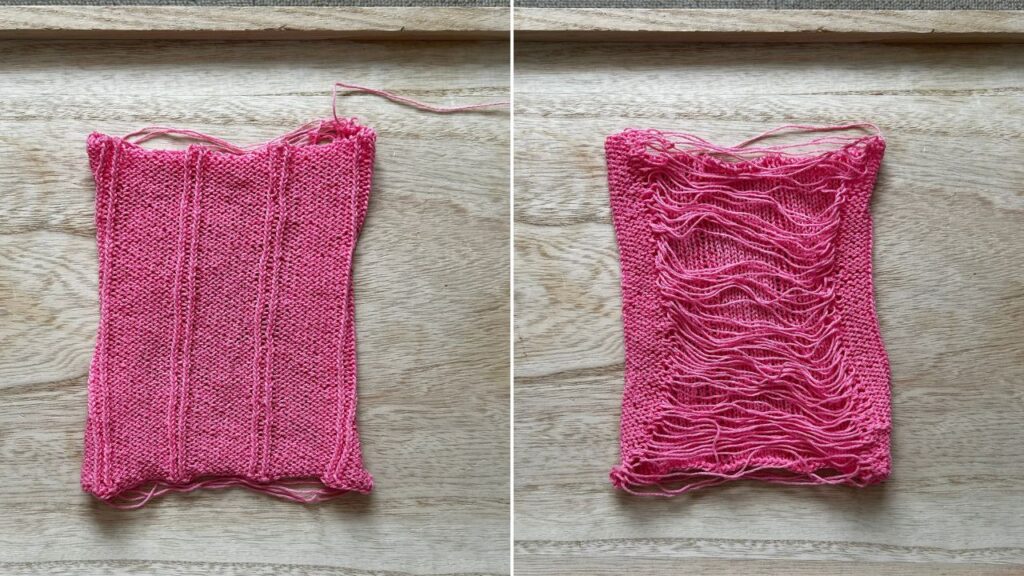
Then I cut the floats, washed the swatch, and steamed it.
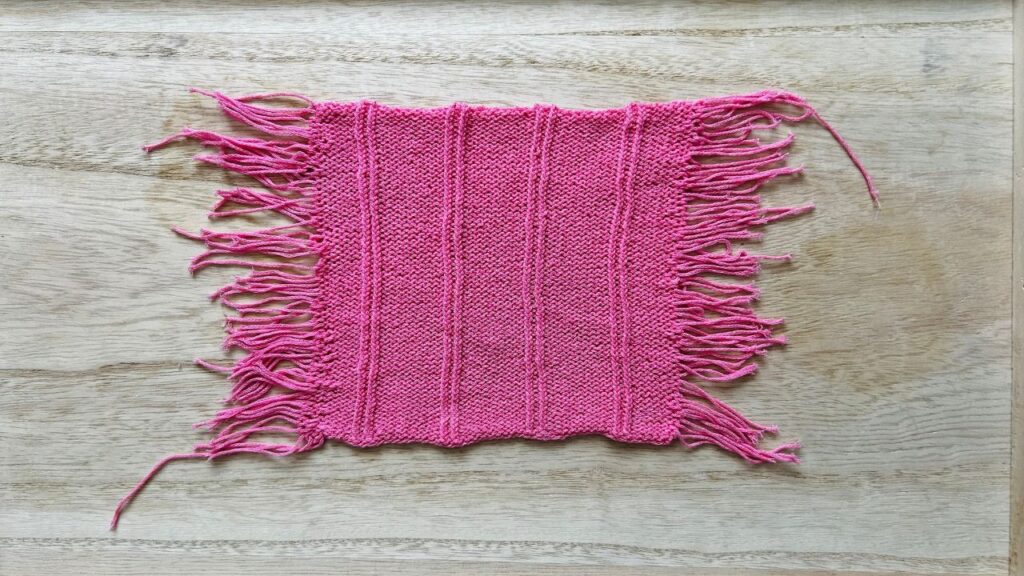
Hmm…
I understand why this method produces a more accurate knitting gauge.
And now I know how to do it properly.
But honestly?
I still hate cutting the yarn.
And for some reason, the carried strands on the back gradually got tighter and shorter while knitting, which made the process awkward.
Also… I’ve already experienced gauge mismatches plenty of times in my knitting life.
So part of me kept thinking:
“Do I really need to go this far…?”
But probably yes.
I mean, Patty Lyons spends a lot of pages talking about gauge in her book Patty Lyons’ Knitting Bag of Tricks.
If she’s that passionate about gauge swatching, it clearly matters.
By the way, I suspect this fake in the round swatch method would be easier using double-pointed needles.
But my DPN collection doesn’t include enough matching sizes, and the actual project will be knitted with circular needles anyway.
And if I change tools just because the swatch is easier to knit… doesn’t that defeat the purpose of swatching?
Patty even says that gauge can change depending on the type of needle you use—even in the same needle size.
Maybe I’m just not a very disciplined knitter.
So from now on, I’ll probably continue knitting flat swatches… while fully aware that it’s technically not correct.
The knitting police are going to arrest me for this.
…quietly hides flat swatch behind back
Final Thoughts on Knitting Gauge in the Round
Technically speaking, the most accurate way to measure gauge for knitting in the round is to swatch in the round as well.
So if you’ve been doing it “kind of vaguely” like I was, I do recommend trying a proper circular knitting swatch at least once.
That said… I’ll probably keep knitting flat swatches most of the time.
In other words, I’m choosing to give up on perfectly accurate gauge. 😂
However, for stranded colorwork knitting, this method is definitely the better choice—not just “maybe.”
So I’d like to challenge myself again when I work on that kind of project.
This method can still feel awkward and time-consuming, and there’s always room for error, so try it at your own risk.
But if you absolutely don’t want your finished project to fail, I highly recommend knitting a proper swatch in the round and measuring your gauge carefully.
About the Book Mentioned in This Article
The English edition already exists.
Book Title: Patty Lyons’ Knitting Bag of Tricks by Patty Lyons.
The edition I read was the Japanese translation of the original English book.