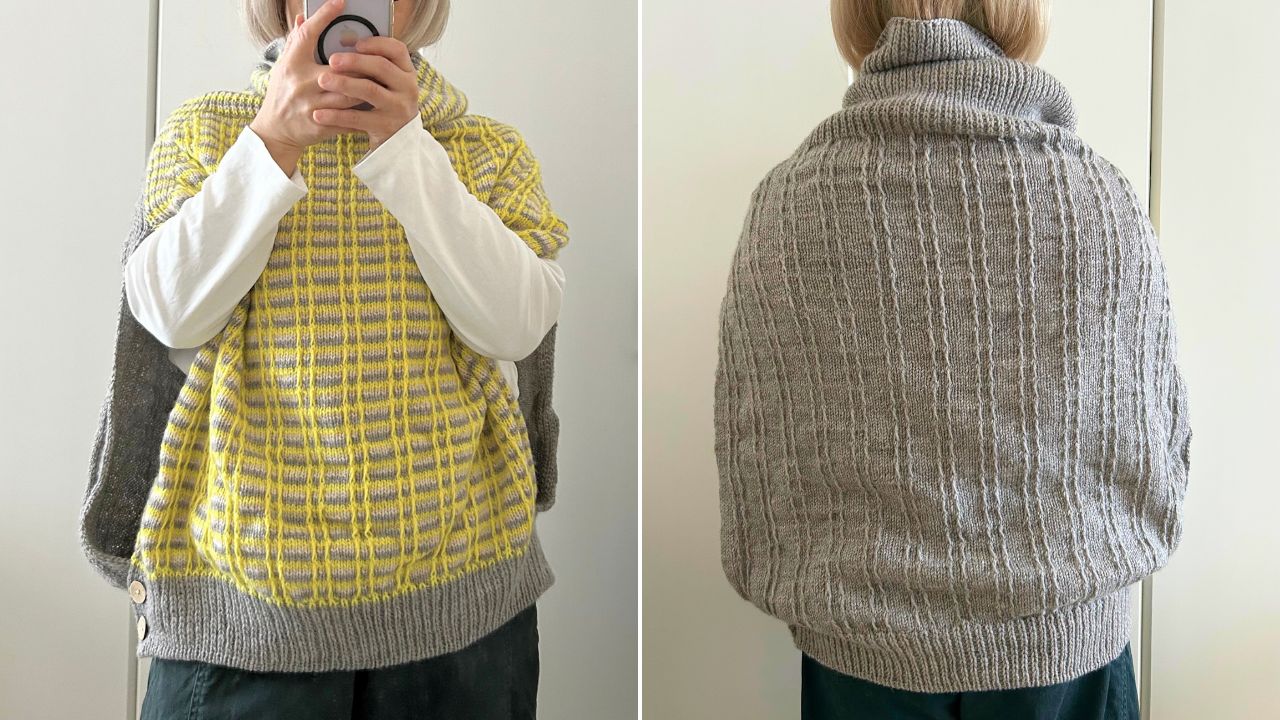
I finally finished my FIVE during Golden Week—a long holiday in Japan that falls in early summer.
This project had been sitting unfinished since the 2025–2026 AW season.
Earlier, I was saying things like “I want to start knitting with summer yarns already!” and even planned out my summer projects…
But honestly?
None of my summer swatches were working out.
So I decided to stop overthinking and just clear my knitting backlog.
And that’s how FIVE got finished.
If you’re curious about how I chose my substitute yarn, check out Part 1 here:

Easy to Knit|Why FIVE Works Even for Beginners

The construction is very straightforward—just follow the pattern as written.
For the body length, the instruction is simple:
“Repeat the pattern until your desired length.”
I knitted the front panel first until I thought, “This should be about right,” then paused it and worked on the back panel.
Once both panels were the same length, I temporarily joined them and tried it on to check the fit.
After confirming the length, I moved on to the hem.
Hem Detail|Modified Rib & Bind-Off Choice (Tubular BO Recommended)
The hem uses a modified rib on the WS:
P1, [Sl1 wyif, K1] repeat
For the bind-off, the pattern suggests:
“Tubular BO or any stretchy bind-off”
That’s when I remembered something.
When I knitted the Artisane Cardigan, I learned that Italian BO = Tubular BO, but I chickened out and used a standard bind-off instead.
This time, I committed:
I’m doing Tubular BO properly.
In English patterns, “Italian BO” can sometimes mean a simple stretchy bind-off—or the full tubular method with setup rows. Context matters.
How to Do Tubular BO|Setup Rows Are Everything

The key to a good Tubular BO is:
Creating thickness with setup rows
Assumption:
Flat knitting in rib with knit stitches at both edges
(Here explained using FIVE’s modified rib, but adaptable to 1×1 rib or in-the-round knitting)
Steps for Tubular BO
WS: Purl, [Sl1 wyif, P1] repeat, end with purl
RS: Separate knit and purl stitches onto two needles
→ Front needle = knit stitches
→ Back needle = purl stitches
Then bind off using a tapestry needle, as in standard grafting.
A helpful video:
Applying Tubular BO to FIVE’s Modified Rib
I wish I had taken photos… but here’s the explanation.
FIVE’s rib looks like 1×1 rib on the RS, while the WS includes slip stitches.
That WS structure is actually very similar to Tubular BO setup rows—so the transition feels natural.
Steps:
- Knit the hem as instructed
- Move directly into setup rows (from RS if your last row was WS)
- Perform setup rows as described above
- Separate stitches onto two needles
- Use a tapestry needle
That’s your Tubular BO result.
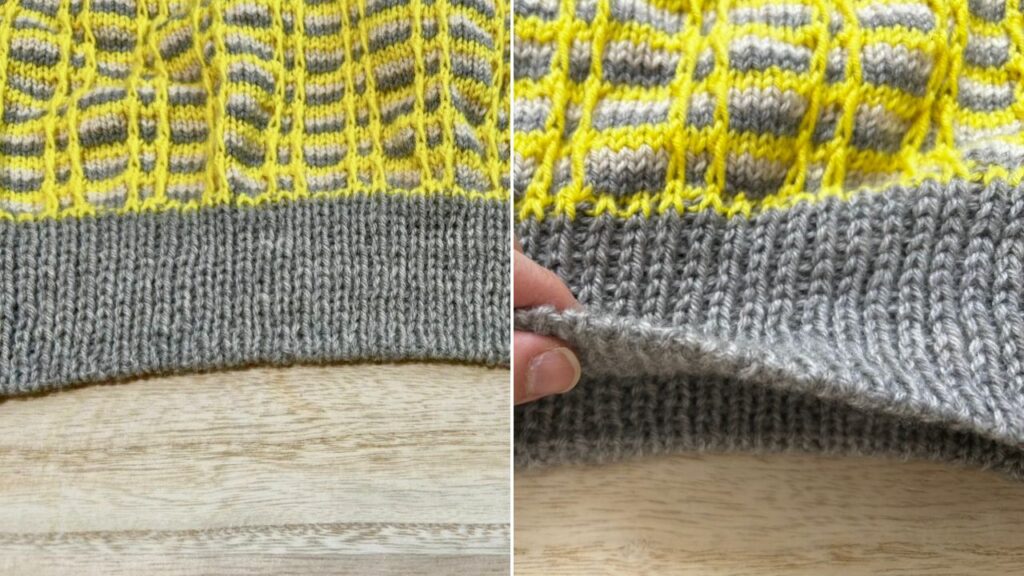
Honestly?
It does create a thicker, more rounded edge—but visually…
You might think:
“Isn’t this basically the same as a regular bind-off?”
So personally, I’d say:
Use Tubular BO when you want that polished finish—but don’t force it when yarn is tight or you’re feeling lazy.
Finishing|Blocking & Buttons
After knitting both panels, seam from collar to shoulders.
For finishing:
- I used Hamanaka Amerry
- It’s a reliable yarn, so steam would work—but since it’ll be stored during warmer months, I wet-blocked it
Blocking guide:
Note: I skipped pre-wash this time since I was just shaping the fabric.
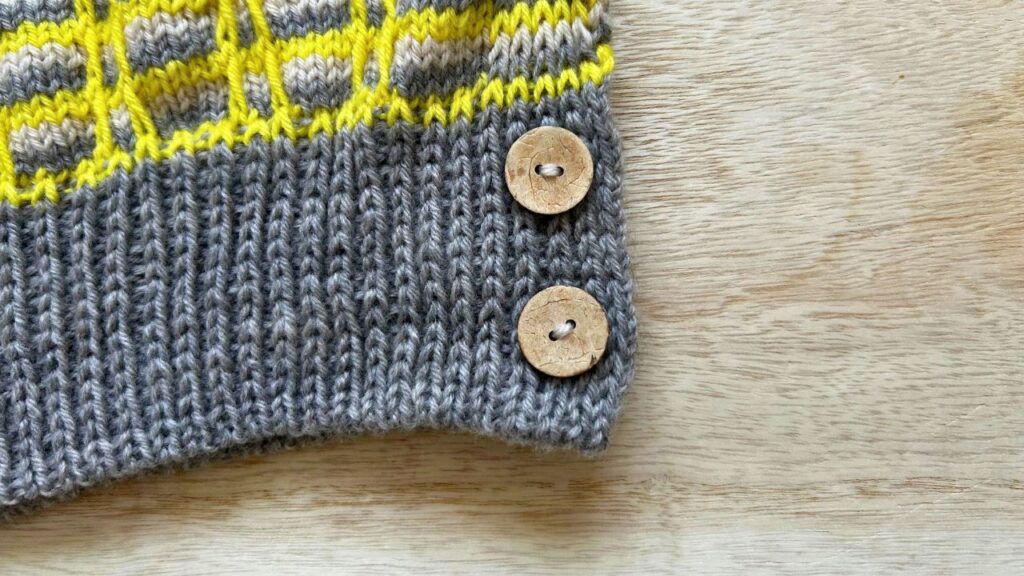
Once dry, I added buttons to the hem.
Luckily, I had the perfect size in my stash.
(The slightly crooked button? Let’s call it charm.)
FIVE Review|How It Actually Fits
Tried it on!
…it looks great.
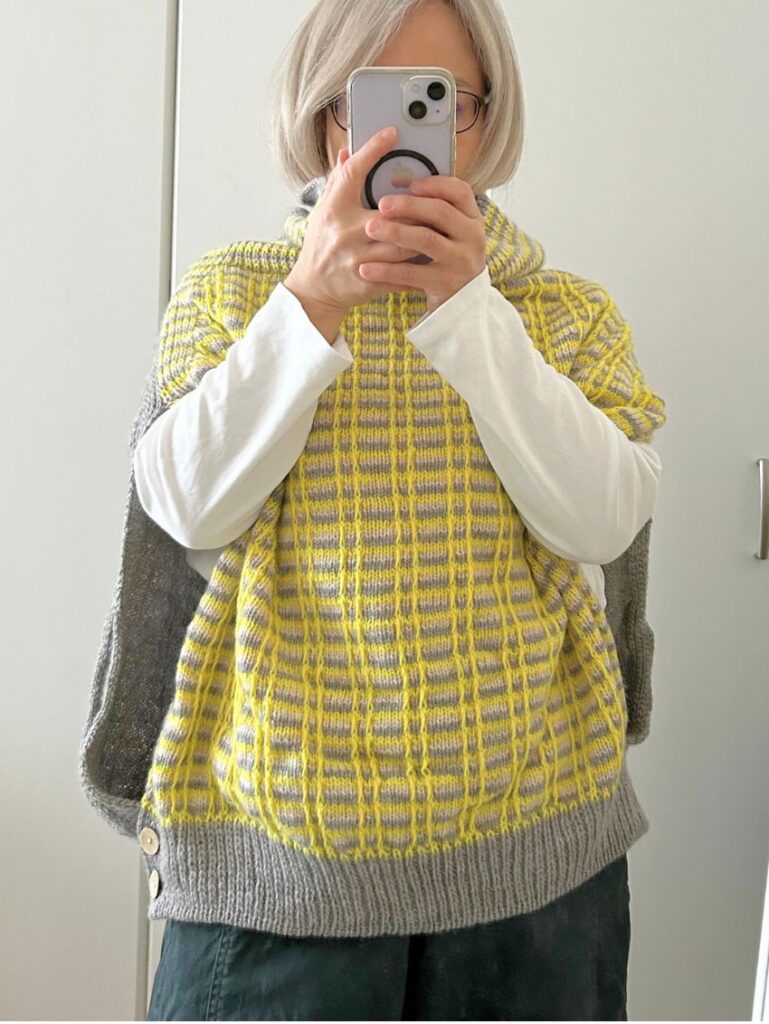
From the side? Even better.
The collar height is super cute.
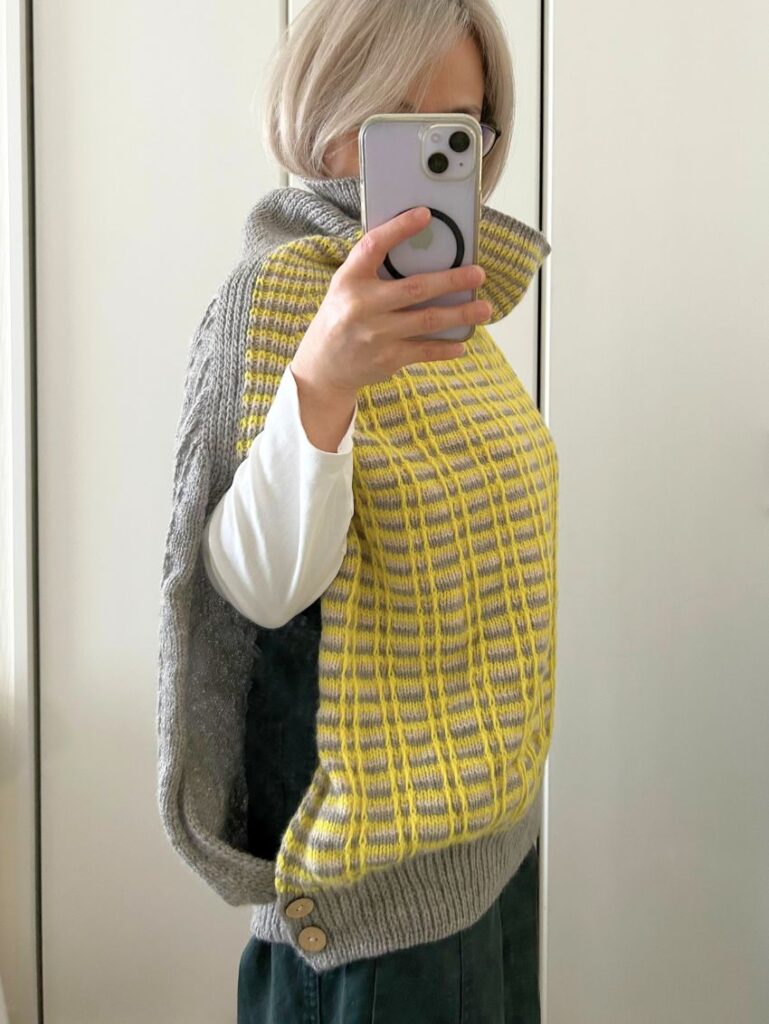
BUT—
Remember:
“Repeat until desired length”
Yeah… I may have gone a bit too far 😅
I originally wanted a cropped fit with slight bunching at the waist.
But Amerry is so smooth to knit, and the stitch pattern is addictive…
I just kept going.
I did realize midway:
“Hmm, this is getting long.”
But undoing it felt like too much effort—so I committed.
Honestly though?
It still works.
And if I change my mind, I can always rip back later.
Pattern & Yarn Notes
If you’d like to knit your own FIVE, you can get the pattern here:
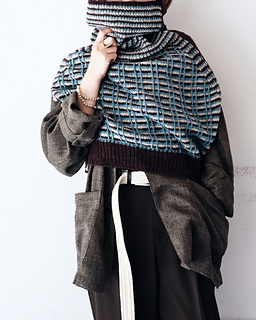
Available in both Japanese and English.
Skill-wise:
- Tubular BO is the only tricky part
- Otherwise beginner-friendly
- No chart-reading required
If you’re knitting this outside Japan, I’d recommend trying a budget-friendly yarn that’s easily available in your area.
Yarn Leftovers
- Gray (22): 13 skeins → ~4+ skeins left
- Yellow (25): 4 skeins → 2 left
- Beige (21): 5 skeins → ~3+ left
(I calculated yellow & beige in reverse)
I’m planning to use the leftovers for a Tilden sweater from a michiyo pattern.