This article is for anyone who feels tired of chasing reactions on social media,
or for those who haven’t been able to take the first step yet.
“How much would you pay for this?”
“Do you think this would sell?”
I’m not a professional maker, and I don’t sell my work.
But since I knit, I’ve started seeing these kinds of posts more and more often.
And I get it.
You put time and care into something, so of course you want it to be recognized.
And if possible, you’d like to avoid failure.
But if you’re serious about selling your work,
or becoming a maker,
those questions might actually be taking you the long way around.
Because there’s a much simpler way to get your answer.
If it sells, it sells.
If it doesn’t, it doesn’t.
So first—put it out there.
That’s the fastest and most accurate way to find out.
“It Sells or It Doesn’t” — That’s All There Is
To be honest, when I look at handmade pieces on social media,
there are times I think, “This might be a bit tough to sell as it is.”
At the same time, I also see pieces that clearly have potential,
yet seem undervalued in the comments.
Which means this:
Social media reactions aren’t very reliable.
Some people will praise out of kindness.
Others will judge based on personal taste or mood.
There’s no consistent standard there.
But the market is different.
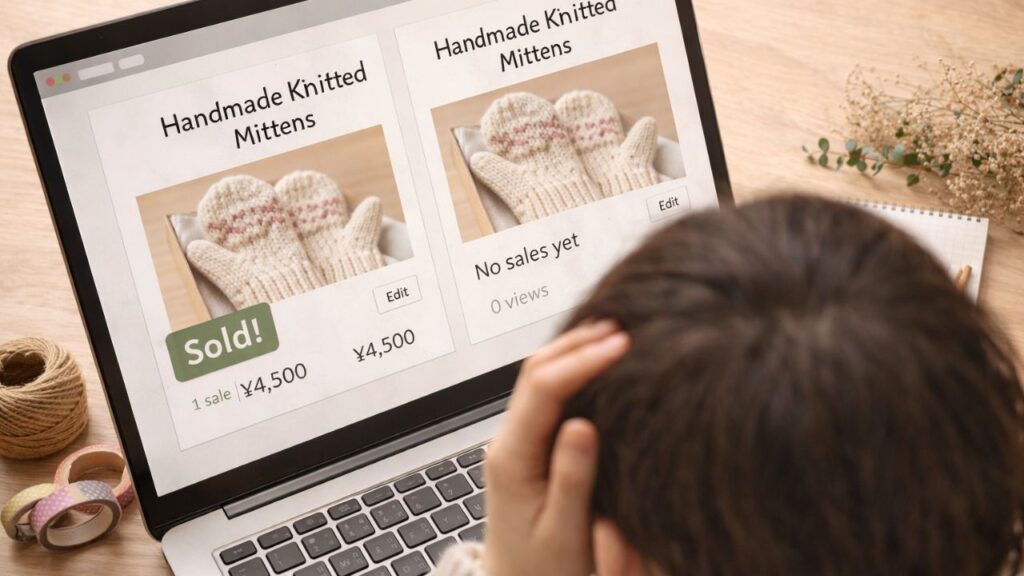
- If it sells, it sells.
- If it doesn’t, it doesn’t.
It’s simple. And it’s fair.
Even if something doesn’t sell, that’s not a failure — it’s data.
What didn’t connect? What could be improved?
A sellable piece isn’t something that appears fully formed from the start.
It’s something that gets refined through trial and error.
Putting your work out there gives you the clearest and most honest feedback you can get.
Your Strength Becomes Clear Because There’s Variety
I’ve also seen posts where makers get frustrated, saying things like,
“Low-quality work is lowering the value of handmade as a whole.”
But honestly, that’s not how it works.
The market naturally contains a wide range of styles, skills, and price points.
And because of that, your own strengths and uniqueness become clearer.
If your work has real value, and it’s presented in a way that reaches people,
it won’t lose its worth just because other kinds of work exist.
And if things aren’t working yet,
there’s no reason to stop there.
Everyone starts somewhere.
With each adjustment, your results will change.
Instead of spending energy judging others,
it’s far more productive to invest that energy into your own work.
Instead of Asking on Social Media, Put It on the Market

Asking “How much would you pay for this?” on social media
might seem like an efficient shortcut.
But in reality, it’s a bit vague.
People may respond kindly but never actually buy.
Or they may give harsh feedback that doesn’t reflect the real market at all.
And there’s something else worth thinking about.
Let’s say someone gives you a price.
Even if that price doesn’t cover your material costs or your time,
would you still accept it?
Of course, some people feel happy just knowing that someone would buy their work.
That’s a valid perspective.
But if you want to keep going —
if you want to build something sustainable —
you need profit.
Pricing shouldn’t be based on someone else’s kindness.
It should come from your own decisions.
That’s why it’s far more reliable to put your work on the market
and look at actual numbers.
It might feel scary at first.
But:
- Put it out there
- See what happens
- Adjust if needed
That cycle is what builds real skill.
In the end, you’re the one who has to decide.
But the information you need is already out there.
Final Thoughts: Handmade Doesn’t Have to Be Complicated
The handmade market is full of talented people and beautiful work.
That’s not a problem — that’s the reality.
And within that reality, your work will either reach someone, or it won’t.
But here’s the important part:
Something that doesn’t appeal to one person
can be exactly what someone else has been looking for.
That’s what makes handmade meaningful.
So you don’t need to rely on opinions from social media.
And you don’t need to let those opinions define your value.
If you’re unsure, don’t wait for permission.
Put your work out there.
See what happens.
Then decide what to do next.