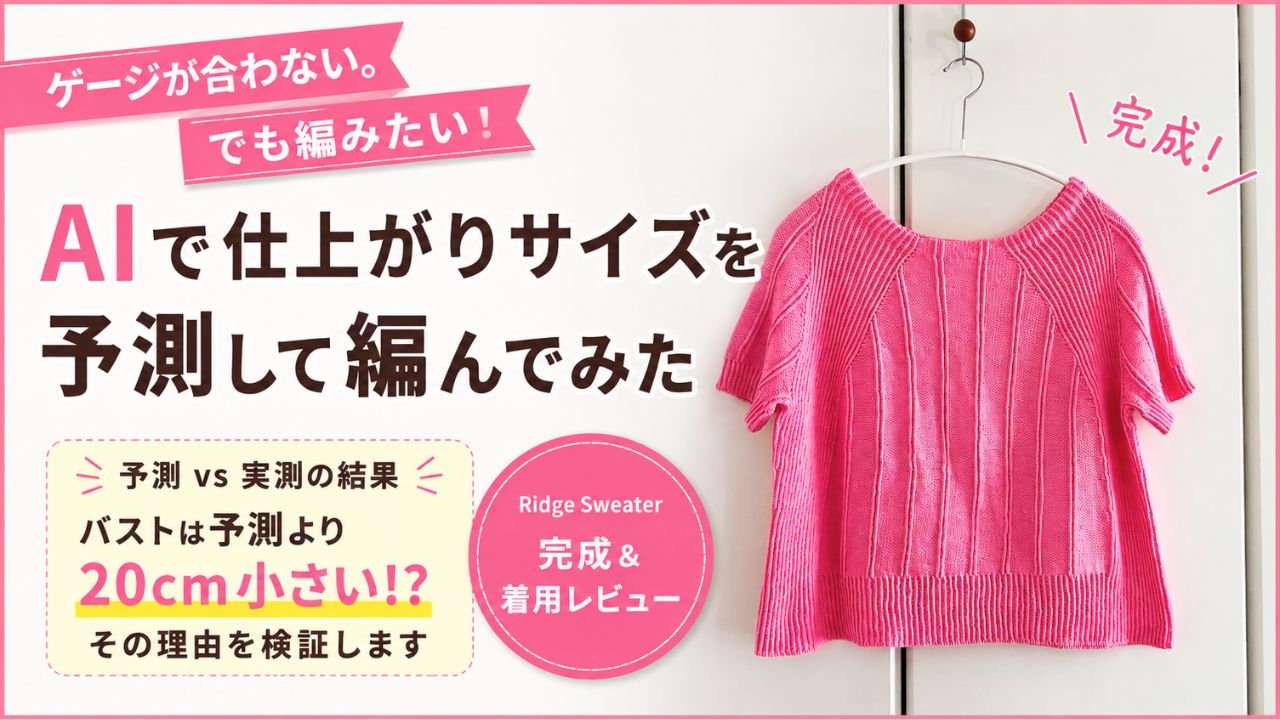
I wanted to knit this sweater with a particular yarn.
There was just one problem:
My knitting gauge didn’t match the pattern.
But I still wanted to knit it.
So what do you do when the yarn you want to use won’t give you the pattern’s specified gauge?
One option is to recalculate the pattern yourself using your actual gauge.
But what if you could ask AI to do the math for you?
That was the idea behind this experiment.
I wanted to find out whether ChatGPT and Gemini could predict the finished measurements of a sweater using my actual gauge, and whether I could use those predictions to choose the right pattern size.
The project I chose was the Ridge Sweater.
In Part 1, I used ChatGPT and Gemini to calculate the expected finished measurements and decided which size to knit.
And then I actually knitted it.
Now it’s finished.
So, the big question is:
Did AI get it right?
Let’s find out.
- My Ridge Sweater Is Finished: Comparing AI’s Predicted vs. Actual Measurements
- AI’s Predicted Finished Measurements for My Ridge Sweater
- My Ridge Sweater Fits! But Did AI Actually Predict the Size Correctly?
- Why Was AI’s Knitting Size Prediction So Far Off?
- What I Learned About Using AI to Adjust Knitting Gauge
- Read Part 1: How I Used AI to Choose the Size
My Ridge Sweater Is Finished: Comparing AI’s Predicted vs. Actual Measurements
I wanted to knit the Ridge Sweater with a yarn different from the one recommended in the pattern.
Unfortunately, I couldn’t reproduce the pattern’s specified gauge with the substitute yarn I chose.
So I knitted a swatch with the actual yarn I planned to use and measured my gauge.
Then, using my gauge and the finished measurements listed for each size in the pattern, I asked AI—both ChatGPT and Gemini—to calculate which pattern size would give me a finished sweater closest to my desired measurements.
The result?
I decided to knit Size 5.
I explained the calculation process in detail in Part 1, including the conditions and measurements I gave to the AI.
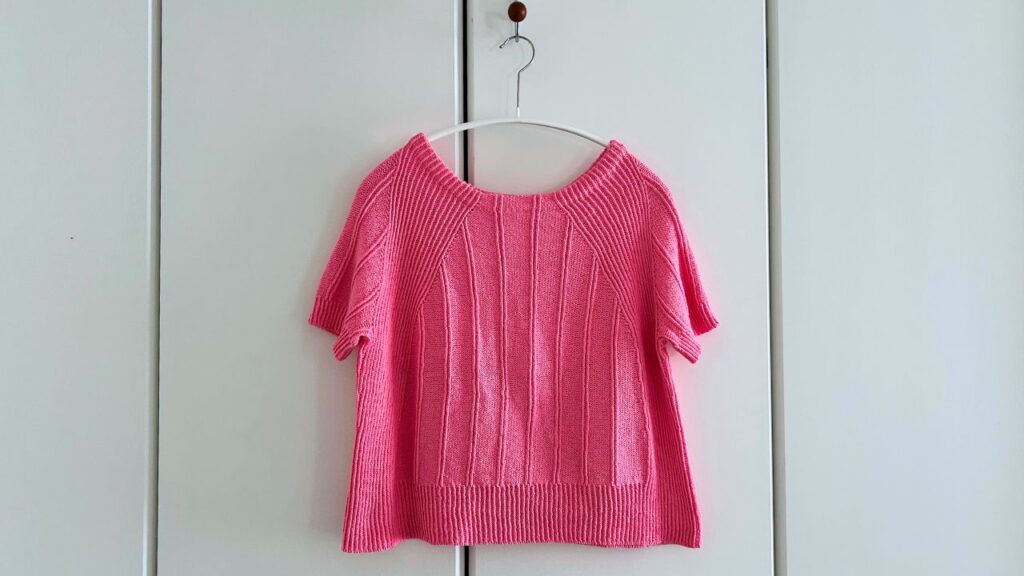
And then—
It was finally finished!
At first glance, it looks pretty promising.
So now it’s time to compare the prediction with reality.
Did AI get the finished measurements right?
AI’s Predicted Finished Measurements for My Ridge Sweater
First, let’s take another look at the finished measurements AI calculated for me in Part 1.
The Ridge Sweater is a top-down knitting pattern, which means I could adjust the body length as I knitted.
For that reason, I left the finished length out of this comparison.
For me, the two measurements that matter most when deciding whether a sweater will actually fit are the bust circumference and armhole circumference.
So this time, I’m focusing on those two measurements and comparing AI’s predictions with the actual finished measurements.
Comparing AI’s Predictions with the Actual Finished Measurements
| Measurement | AI Prediction | Actual Measurement | Difference |
|---|---|---|---|
| Bust | Approx. 116 cm | 96cm | – 20cm |
| Armhole Width | Approx. 31.3 cm | 32cm | +0.7cm |
…Wait.
The bust measurement is off by 20 cm.
On the other hand, the armhole is only 0.7 cm off.
What the heck?!
So… did AI get it right or not?
Honestly, I’m not quite sure what to make of these results.
My Ridge Sweater Fits! But Did AI Actually Predict the Size Correctly?
Well, the AI calculations turned out to be… interesting.
But the goal of this project wasn’t simply to get AI to produce perfectly accurate numbers.
After all, I started this project because I wondered:
“Even if my gauge doesn’t match the pattern, could I use AI to figure out which size to knit for a good fit?”
If that was the goal, then ultimately—
If I can wear it and it fits well, I’ll call it a success!
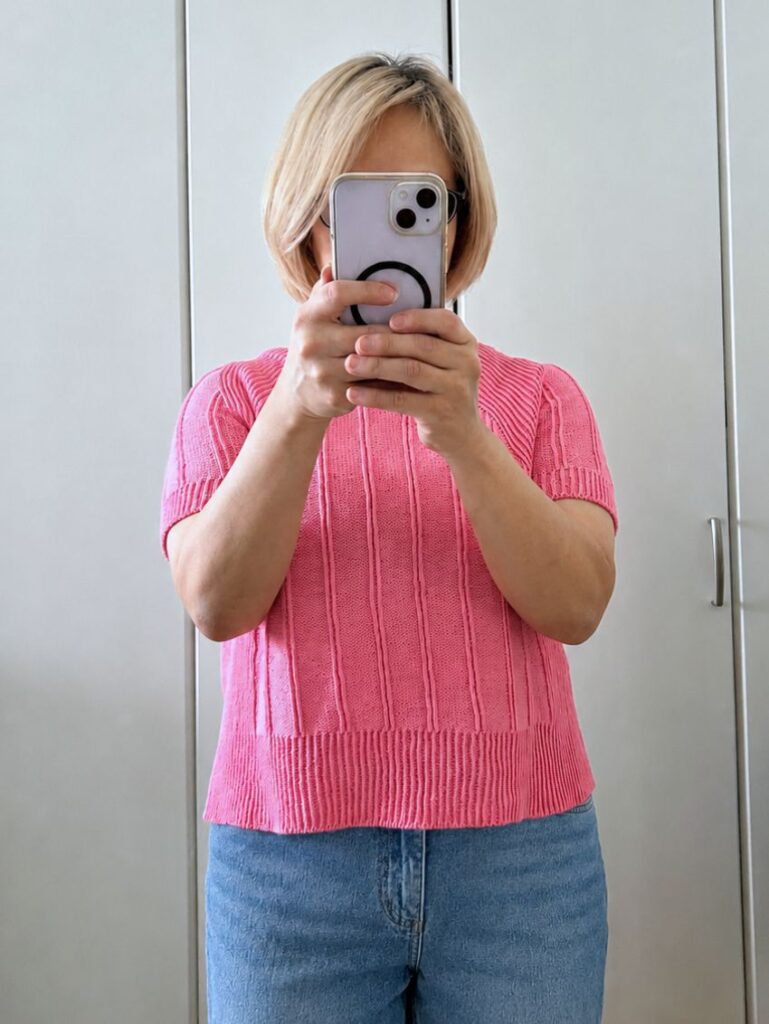
So, I tried it on.
…
Oh, yeah!
This is good! Really good!
It fits perfectly!
It has a light, easy feel—almost like wearing a T-shirt.
The body circumference is more fitted than I expected.
But it doesn’t feel tight or restrictive at all.
So, with that—
the Ridge Sweater knitting project itself was a success!
…
But wait.
We can’t stop here.
Because the whole point of this experiment was to see how accurately AI could predict the finished measurements of a knitted sweater.
Why Was AI’s Knitting Size Prediction So Far Off?
This experiment started with a simple idea:
If my gauge doesn’t match the pattern, but the pattern offers a wide range of sizes, why not have AI calculate the expected finished measurements using my gauge, choose the size that should give me the measurements I want, and just knit it?
Well…
After actually knitting the sweater, the results were:
Bust: 20 cm off.
On the other hand:
Armhole: only 0.7 cm off.
Based on these results, I definitely can’t conclude that “If you let AI do the calculations, you can get the size you want even when your gauge doesn’t match the pattern!”
If anything, this experiment completely destroyed that idea. LOL.
So, why did I get such a strange result?
Could Blocking Affect the Finished Sweater Size?
The first thing I considered was the effect of wet blocking.
The yarn I used is 100% super long-staple, high-twist cotton—in other words, a very tightly twisted cotton yarn.
I tried the sweater on before blocking, and the fabric felt a little rough and somewhat loose.
The fit at that point was nicely shaped around my body.
But once the fabric got wet, something surprising happened:
It became remarkably stiff.
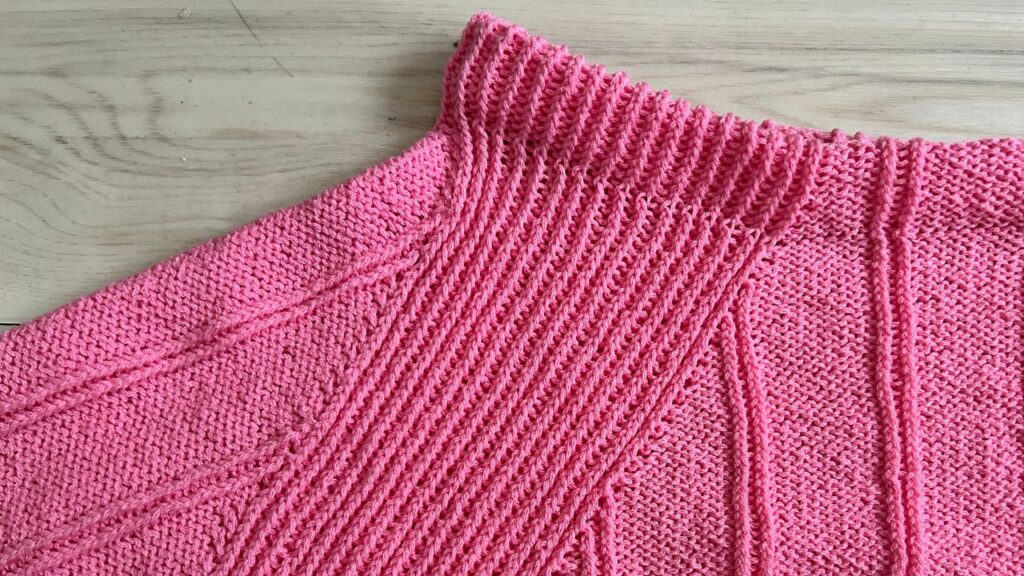
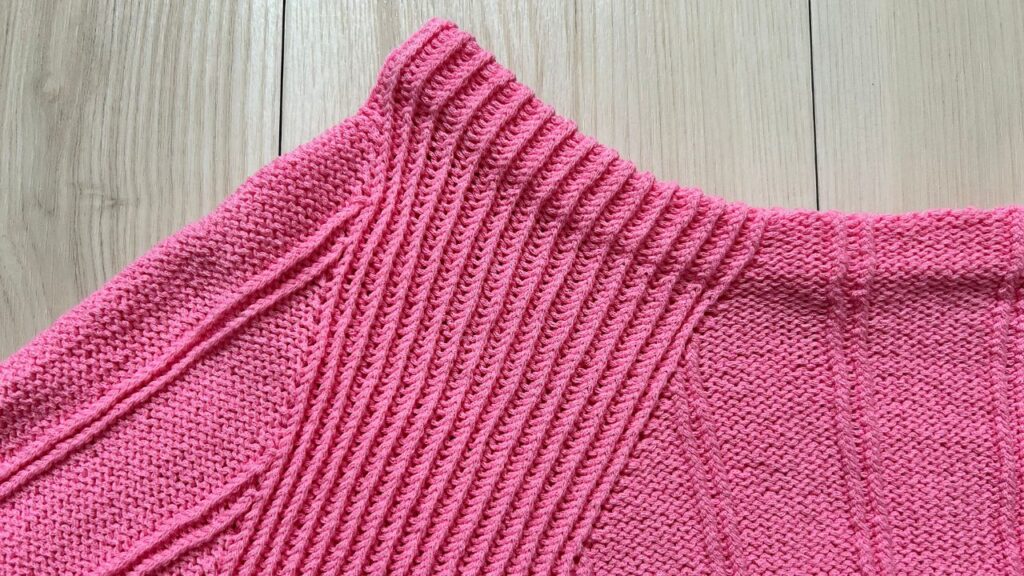
After it had dried completely, the fabric became a little fuller and softer than it had been before blocking.
If you compare the twisted ribbing in the image above (before blocking) with the image below (after blocking), you can see that the stitches look more compact after blocking.
Could the sweater have ended up smaller than expected because the fabric became stiffer and less stretchy when it absorbed water?
Well…
Not so fast.
I actually measured my gauge after blocking in the first place.
And the fabric becomes softer again once it dries, too.
So it seems unlikely that blocking alone caused the bust circumference to shrink by 20 cm.
As for the texture, though, the roughness softened into a pleasant, linen-like crispness. And honestly, it feels quite nice to wear.
Could Knitting Tension Affect the Finished Size?
Of course, I have to consider this possibility too.
Hand knitting isn’t machine knitting, so maintaining exactly the same tension throughout an entire sweater is surprisingly difficult.
Even when the same person uses the same yarn, tension can subtly change depending on where you are in the project, when you’re knitting, or whether you’re working a stitch pattern.
So even if I knit based on numbers calculated by AI, the final result is ultimately determined by my human hands.
I can’t knit every stitch at exactly the same density as the mathematical model assumes.
Did I Give AI Enough Information to Predict the Size?
This is the part I really want to think about.
The interesting thing is that, AI aside, there are mathematical formulas for calculating finished measurements from gauge.
In other words, it’s not that “you can’t predict the finished size because your gauge is different.”
If you properly understand the construction of the pattern, extract the necessary numbers, and correctly account for the actual gauge, the calculations should be possible.
So perhaps the real problem wasn’t that AI couldn’t do the calculation.
It’s much more likely that there was something wrong with the information or conditions I gave AI, or the way I interpreted the pattern.
That’s something I’ll need to investigate further.
And this is where my own knitting knowledge and skills come into play, too.
After seeing these results, it would be easy to simply say:
“AI failed!”
But where’s the fun in that?
Instead, I think it’s much more useful to ask:
Why did AI get the armhole almost exactly right, while missing the bust measurement by a whopping 20 cm?
Figuring that out could make the next experiment much more successful.
What I Learned About Using AI to Adjust Knitting Gauge

To be honest, I’m a little disappointed with the results.
I still think the basic idea behind this experiment was sound.
“If my gauge doesn’t match the pattern, could I choose a different size to get closer to the finished measurements I want?”
I believe that approach is still worth exploring.
But this experiment did teach me one important lesson:
And there’s another important takeaway:
Simply asking AI to do the calculations doesn’t guarantee that you can accurately adjust a pattern when your gauge doesn’t match.
This time, the sweater did not end up with the measurements AI predicted.
But when I actually put it on, the Ridge Sweater turned out really well.
So, as an experiment to test AI-based knitting size prediction, I’d call it a failure.
But as a knitting project that resulted in a sweater I’m happy to wear, it was a success.
A slightly strange result, perhaps—but a pretty interesting one.
And I’m not ready to give up on the idea of using AI when my knitting gauge doesn’t match the pattern.
I’d like to explore this a little further.
For example, what information should I give AI to make its finished-measurement predictions more accurate? I’d like to experiment with that, including the prompt I used for this project.
It would also be fun to try the same prompt on other knitting patterns and build up a collection of real-world examples.
If you’ve ever tried something similar, or if you have an idea like:
“If you gave AI this information, maybe it could calculate the size more accurately!”
or
“I’ve knitted a project using a similar method!”
—I’d love to hear from you in the comments.
I’ll definitely keep your ideas in mind the next time I find myself thinking:
“My gauge doesn’t match… but I really want to knit this!”
Read Part 1: How I Used AI to Choose the Size
So, how did I end up choosing Size 5 for my Ridge Sweater in the first place?
Before I could test whether AI could predict the finished measurements, I had to figure out how to deal with my gauge not matching the pattern.
In Part 1, I explain the original gauge problem, the calculations I ran with ChatGPT and Gemini, and how I used their results to decide which pattern size to knit.
→ Read Part 1: How I Used ChatGPT and Gemini to Choose the Right Size