AI is pretty amazing sometimes.
Would I trust it to design an entire knitting pattern? Probably not.
Would I trust it to do a bunch of knitting math for me?
Absolutely.
Right now, I’m knitting the Ridge Sweater, and I’ve run into a familiar problem:
The yarn I wanted to use just wouldn’t give me the pattern gauge.
Normally, that’s the point where many knitters would choose a different yarn.
I, however, decided to be stubborn.
The good news is that Ridge Sweater comes in a wide range of sizes.
So I started wondering:
Could I still end up with the fit I want, even if my gauge doesn’t match the pattern?
There was only one way to find out.
Let’s call this a knitting experiment.
When Your Substitute Yarn Doesn’t Match the GaugeAbout Ridge Sweater
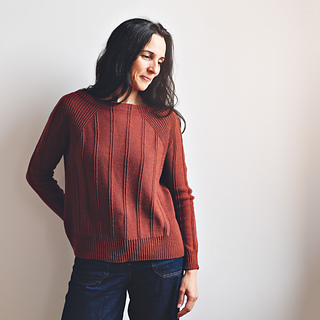
Ridge Sweater is one of those patterns that sat in my Ravelry favorites for quite a while before I finally decided to cast it on.
It’s designed by Hiromi Nagasawa and calls for De Rerum Natura yarn.
What caught my eye was the beautifully defined ridge texture. The fabric looks crisp, modern, and almost architectural.
I’ve decided to knit mine as a short-sleeved version, which feels perfect for spring and early summer.
Why I Chose a Substitute Yarn
The pattern calls for De Rerum Natura, and most suggested alternatives are fingering-weight yarns.
The recommended needle size is US 3 (3.25 mm).
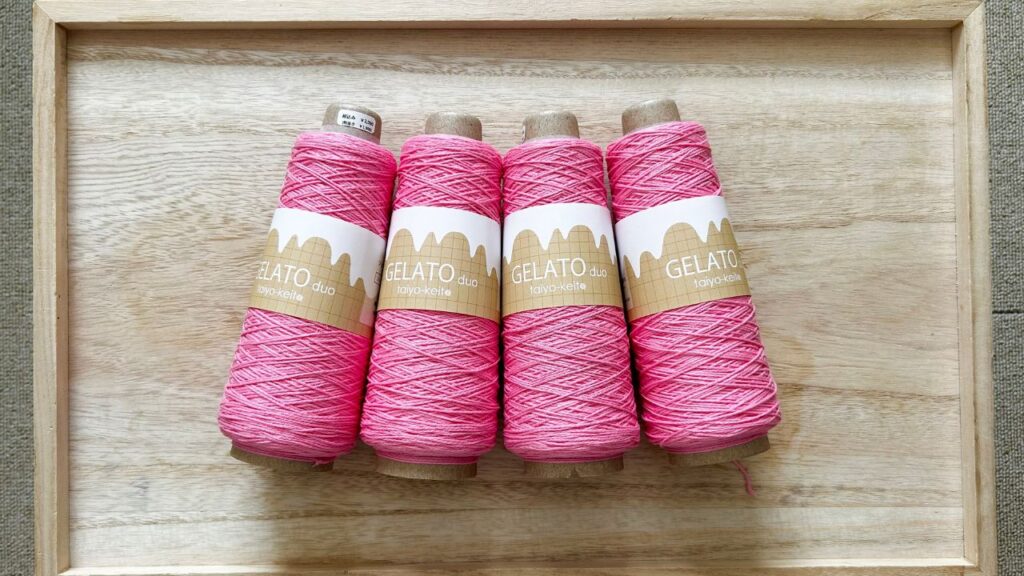
The yarn I wanted to use seemed like it should work on paper.
The recommended needle range was fairly close.
Everything looked promising.
At least until I actually knit a swatch.
As knitters know, that’s usually where reality enters the chat.
Comparing the Pattern Gauge and My Gauge
Ridge Sweater is worked entirely in the round.
Since gauge can change significantly between flat knitting and knitting in the round, I decided to swatch properly this time.
If you’d like to see how I measure gauge in the round, you can read about it here:
The pattern gauge is:
25 stitches × 34 rounds = 10 cm (4 inches)
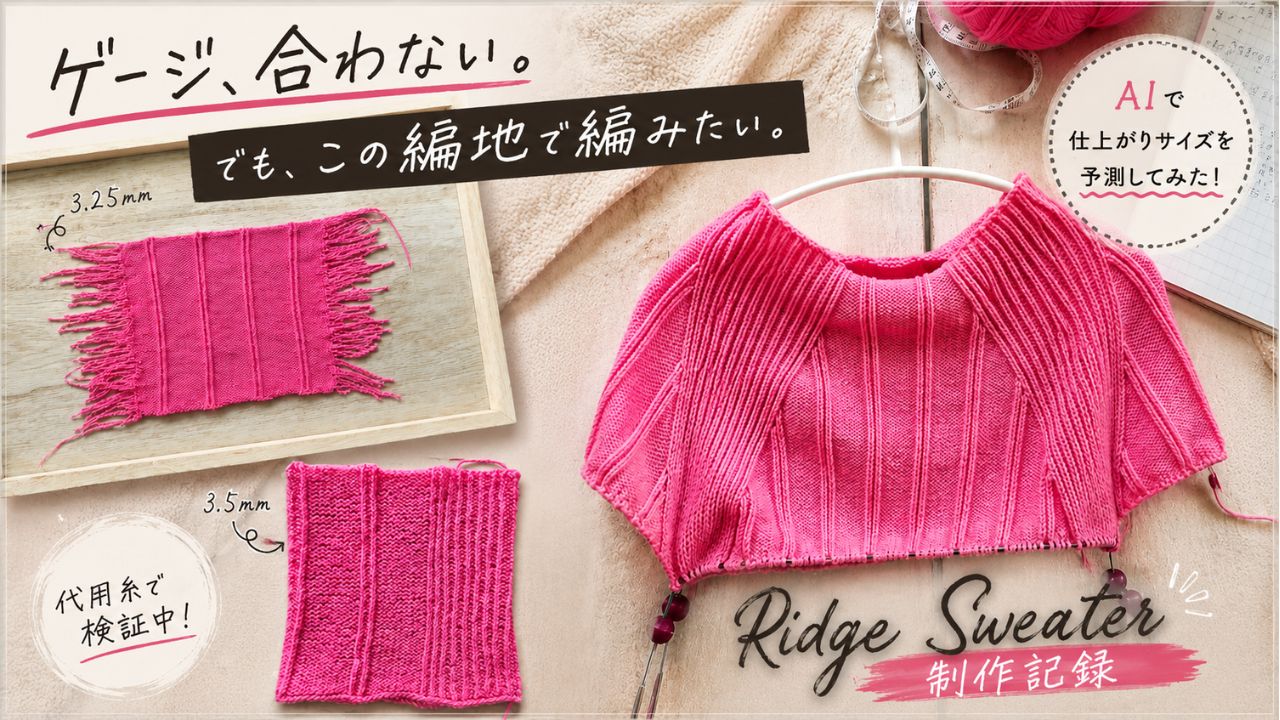
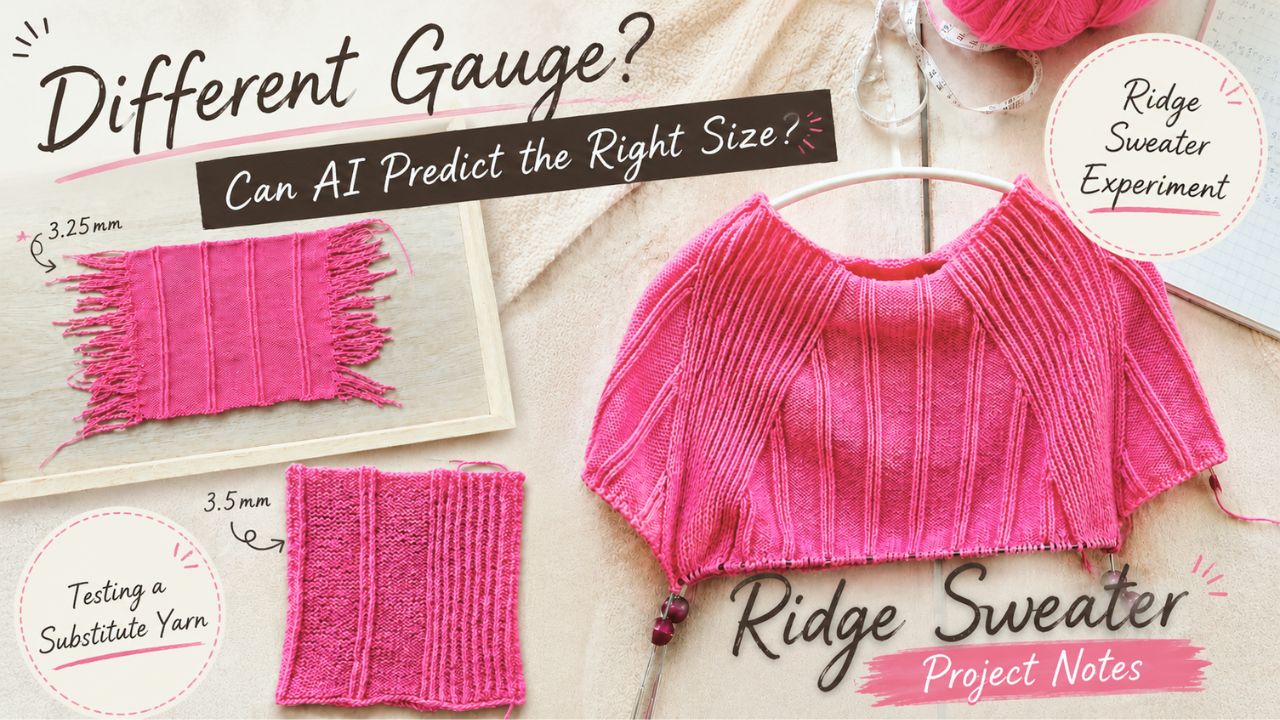
Swatch #1 — 3.25 mm Needles
I started with the recommended needle size.
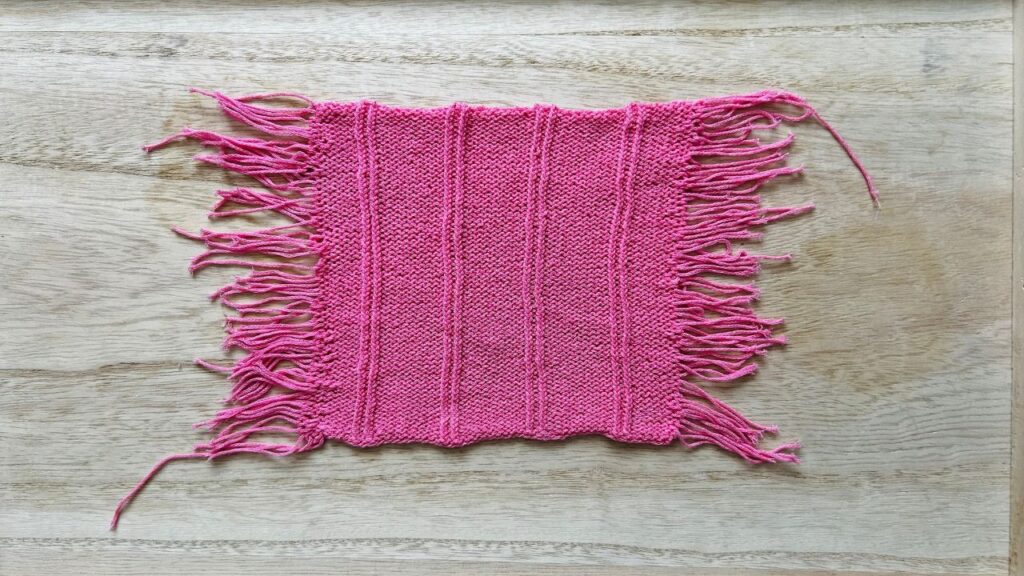
My result:
30 stitches × 44 rounds = 10 cm
Which is… not even remotely close.
The fabric was also quite dense after blocking.
Could I knit a sweater with it?
Sure.
Did I want to wear a sweater made from that fabric?
Not really.
Swatch #2 — 3.5 mm Needles
Next, I tried 3.5 mm needles.
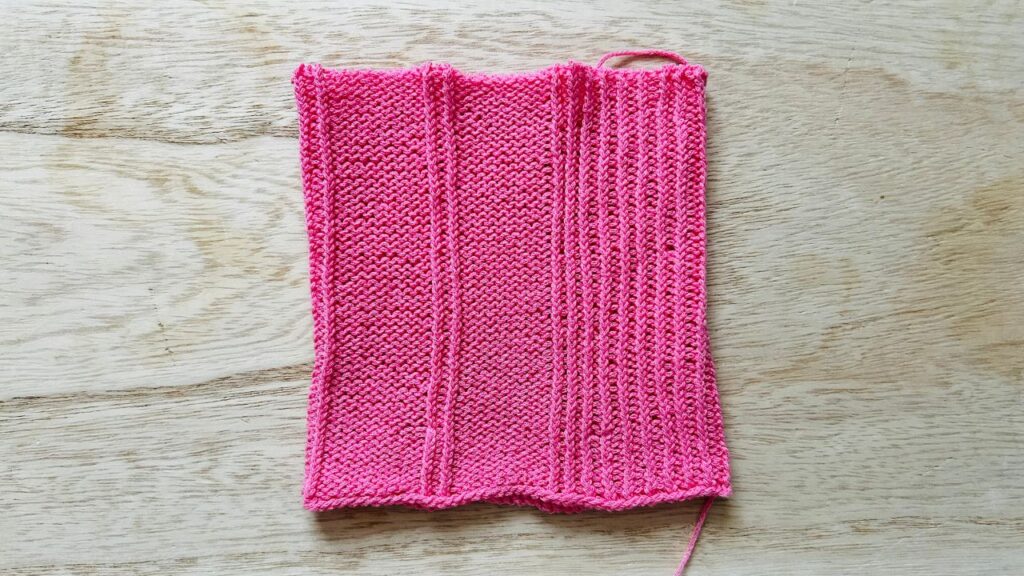
Result:
28 stitches × 41 rounds = 10 cm
Still tighter than the pattern gauge.
But the fabric felt so much better.
I briefly considered going up another needle size to 3.75 mm.
That would probably have brought me closer to the pattern gauge.
The problem was…
I really loved the fabric at 3.5 mm.
You know that feeling when the numbers say one thing, but your hands tell you something else?
Yeah. That.
So I made the very scientific decision of choosing the fabric I liked better.
And that’s how 3.5 mm won.
Using AI to Predict the Finished Size
At this point, I decided to ask both ChatGPT and Gemini the same question.
If my gauge is different from the pattern gauge, which size should I knit to achieve the finished measurements I want?
I’m planning to knit a top-down sweater.
The body length is not important for this calculation because it can be adjusted while knitting.
Pattern Gauge
- Main pattern: 25 stitches × 34 rounds = 10 cm (4 inches)
- Needle size: US 3 (3.25 mm)
My Gauge
- 28 stitches × 41 rounds = 10 cm (4 inches)
- Needle size: 3.5 mm
My Body Measurements
- Bust: 95 cm
- Upper arm circumference: 32 cm
Available sizes:
1 (2, 3, 4, 5)(6, 7, 8, 9)
Finished bust circumference:
97.5 (104, 113, 122, 130)(140, 150, 160, 170) cmUpper arm circumference:
29 (29.5, 30.5, 32, 35)(38.5, 42, 46, 49.5) cmBased on this information, which size would be better for me: Size 4 or Size 5?
Using my gauge, calculate the predicted finished bust circumference and upper arm circumference for both Size 4 and Size 5.
Please present the results in a table.
After running the numbers, both AIs came to very similar conclusions.
The results looked like this:
The two measurements I cared about most were:
- Predicted bust circumference
- Predicted upper-arm circumference
The bust wasn’t a concern.
Even Size 4 or Size 5 would give me plenty of ease.
The sleeves, however…
The sleeves were making me nervous.
According to the calculations, even Sizes 4 and 5 might end up smaller than my actual upper-arm measurement.
Which feels… less than ideal.
Sure, knitted fabric stretches.
And yes, seamless garments tend to be forgiving.
But still.
I couldn’t stop imagining sleeves that looked vacuum-sealed onto my arms.
I considered knitting Size 6 instead.
But then the bust would end up much larger than I wanted.
At this point, the project became less of a plan and more of an experiment.
Or maybe a gamble.
Possibly both.
If the AI predictions turn out to be accurate, that would be genuinely useful information:
That’s exciting.
But let’s be honest.
Knitting isn’t performed by spreadsheets.
It’s performed by humans.
And humans are wonderfully inconsistent.
So even if the math isn’t perfect, I’ll consider this project a success if I end up with a sweater I can actually wear.
Decision Made: I’m Knitting Size 5
After all the calculations, comparisons, and overthinking, I decided to knit Size 5.
Will the sleeves be a little snug?
Probably.
Will Future Me have opinions about this decision?
Almost certainly.
Am I knitting it anyway?
Absolutely.
Casting On Ridge Sweater
So, Size 5 it is.
I’ve officially cast on, and I’ve already reached the sleeve separation point.
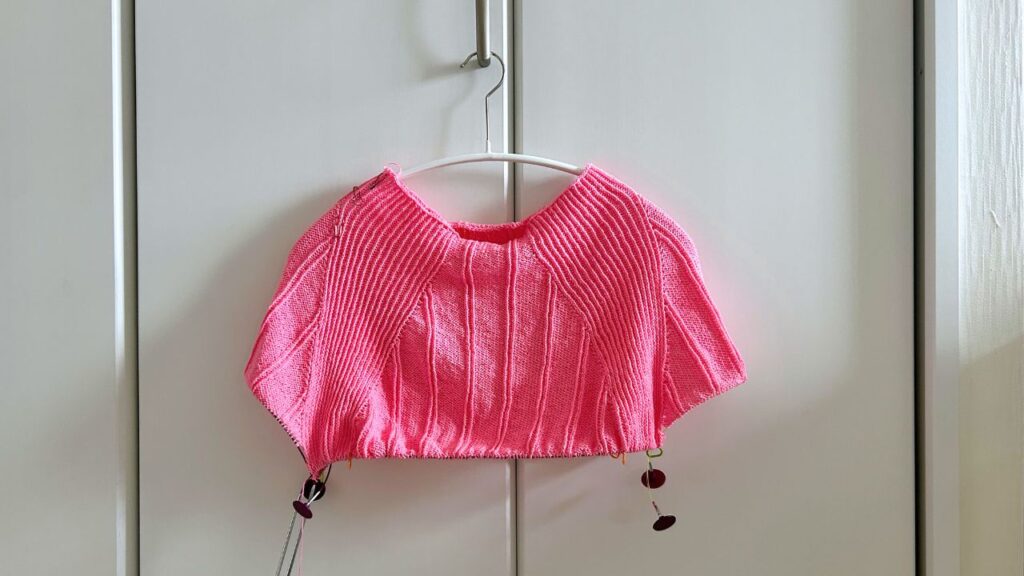
So far, everything is looking promising.
At least, that’s what I’m choosing to believe.
What Happens Next?
That’s it for Part 1.
In Part 2, I’ll compare the actual finished measurements against the AI predictions and see how accurate they really were.
Did AI get the math right?
Was choosing fabric feel over gauge a terrible idea?
Or was it the right decision all along?
I honestly don’t know yet.
But that’s part of the fun.
For now, I’m just going to keep knitting and hope for the best.
See you in Part 2.
Want to Try This With Your Own Project?
If you’re working with a substitute yarn and your gauge doesn’t match the pattern, AI can be surprisingly helpful for estimating finished measurements.
Here’s a prompt template you can copy and adapt for your own project:
I’m planning to knit a top-down sweater.
The body length is not important for this calculation because it can be adjusted while knitting.
Pattern Gauge
- Main pattern: [XX] stitches × [XX] rounds = 10 cm (4 inches)
- Needle size: [XX mm / US size]
My Gauge
- [XX] stitches × [XX] rounds = 10 cm (4 inches)
- Needle size: [XX mm / US size]
My Body Measurements
- Bust: [XX cm]
- Upper arm circumference: [XX cm]
Available Sizes and Finished Measurements
Size 1:
- Finished bust circumference: [XX cm]
- Upper arm circumference: [XX cm]
Size 2:
- Finished bust circumference: [XX cm]
- Upper arm circumference: [XX cm]
(Add additional sizes as needed.)
Task
Using my gauge instead of the pattern gauge:
- Calculate the predicted finished bust circumference and upper arm circumference for each size.
- Compare those measurements with my actual body measurements.
- Calculate the amount of positive ease at the bust for each size.
- Present the results in a table.
- Recommend the best size based on fit, ease, and upper-arm circumference.
- Explain your reasoning.
Assume the knitted fabric has normal stretch, but do not rely on stretch to compensate for significant sizing differences.
AI can do the math, but it can’t tell you which fabric you’ll fall in love with.
That’s still up to the knitter.
Full disclosure: I asked AI to help me write the English version of this prompt.
My knitting is much better than my English. 😆
If you give it a try, I’d love to know how it goes.
Feel free to say hi on Instagram or X, and let me know whether the prompt worked for your project—or if you found a better way to do it!
So, what happened when I actually knitted the sweater using the size AI recommended?
Read Part 2 to see the finished Ridge Sweater, compare AI’s predictions with the actual measurements, and find out whether AI got it right.
→ Read Part 2: Did AI Predict My Sweater Size Correctly?